
We’ll always have Paris.
I was in Paris, eventually, after a crave of years. When people asked me about it, they seemed eager to get an opinion out of me. Do you like it? How is Paris? While in fact, I think Paris has way passed the line that it needs anyone’s opinion of it, certainly not mine.
I remember wanting to go to Paris for most of my life. Why it didn’t happen earlier, I don’t know. I guess I was waiting for “the ideal person” who I wanna go to Paris with. Silly, but true. I have even dated two French boyfriends, but neither of them made Paris happen. I remember telling myself, there is no rush for it, Paris would always be there. But earlier this year, one day in February when I was feeling an unexplained edginess and desperately needed to please myself, I thought, I’m not gonna wait anymore, I’m going to Paris. I booked the trip in the next twenty minutes. When you’re over 30, you would have learned that for many things, you simply have to make it happen yourself. Even Paris. Especially Paris.
Three months later, on the night I arrived, I took a walk around Le Marais, the neighborhood I temporarily lived at, and feeling “wow”, silently marveling at the fact that I was walking in Paris. It’s indeed quite amazing to still be able to feel that way like you’re a little simple girl when you’re in your 30s. On that evening, I felt like a little girl finally getting what she wants. I don’t even care how corny it may seem. I walked around and saw people gathering in casual groups at bars and restaurants, all looking so lighthearted as if life is nothing but a joyous party. It was exactly what I imagined Paris would be.
I settled at a quite busy wine bar with a great google-maps rating. They didn’t have tables anymore, but I didn’t need any table. The single seat at the far end of the bar was calling for me. I had three drinks that night, two ordered by myself, one ordered by a guy who stood by the bar for a while. He is about my age, manages a gallery in Marais. Do you like your job? I asked. I like it, but I don’t always like the arts I’m selling, he said. He left for parties elsewhere and I told him I was too tired to join. That was when I knew my “little girl” moment was gone; I was back to a 31-year-old woman, fatigued and self-reserved.
Paris is truly an inspiring city, like all other great cities. You don’t just feel that from art museums, you feel that everywhere, boutique stores, corner cafes, avant-dressing transgenders, street singers, metro posters. But art, god, art, it has to be what makes Paris great. Here we have to separate art from art business. I always feel more drawn to the traditional art scene than the modern. In traditional art, you see art. In modern art, you see money and vanity. Maybe I’m being unfair. After all, art, like everything else, is always influenced by money. I’m sure Monet had to worry about money at some point, not to mention Van Gogh. But I wasn’t there in their time. I am here in my time, I’ve seen how art business works in the capitalist world, I’ve seen how people become phony and repulsively snobbish and I really can’t appreciate that. Anyways, I was thoroughly in awe when I was in Musée de l’Orangerie watching Monet’s curvy and large-scale Water Lilies. In the museum of Orange Rice (my French ex told me the pronunciation could mean this way), I felt I was one centimeter closer to what art truly is. Art is, in the most simplified way, simply a repetitive practice one conducts towards something one truly loves and appreciates, like Monet’s commitment to his water lilies, like Van Gogh’s commitment to himself. Their works are only so absorbing because of the commitment invested in them.
After several days in Paris, I felt like I could already move about like a local. I’d become quite acquainted with the metro lines, I visited unknown museums after seeing random posters in the Metro, and I had a go-to bar for a nightcap before I went “home”, the wine bar that I went to on the first night. The bartender recognized me when I showed up the second time. He tilted his head towards “my seat”, and I sat there as he hinted. He barely speaks English, and he seemed genuinely apologetic for that. When I tried to make a casual conversation, he frequently came across words from me that he couldn’t make of. He’d then turn to his colleagues and inquired them. One time, I said “I was too old to go to clubs”, he couldn’t understand and turned to his colleague. After getting what it means, he turned back to me and said, “How old are you?” His colleague hinted him that he shouldn’t ask so bluntly, I laughed and said it’s fine, I’m 31.
Most of the time, he was too busy to converse with me anyway. It was really a popular wine bar, always crowded, evidently appreciated by Parisians. The bartender, also the manager of the bar, told me he had been working there for 10 years. I wanted to ask isn’t 10 years a very long lifespan for a bartender? But then I decided it was too complicated a sentence, and only quietly admired his commitment to this job. I think it’s amazing….some people go on holiday, by themselves, he said, I can’t. I’m always with family or friends. I looked at him, this guy that could barely speak English, and felt bitterly amused. In all these years that I travel alone, I’ve heard a lot of people’s comments about it — they’re usually surprised, sometimes they’d say “that’s very brave”. It was indeed the first time I heard people use “amazing” as a comment, and there’s a chance it was simply a misuse of English words. When I left that night, I told him it was my second last night in Paris. “Maybe see you tomorrow?” he said. “Yes, maybe.” I didn’t go back in the end.
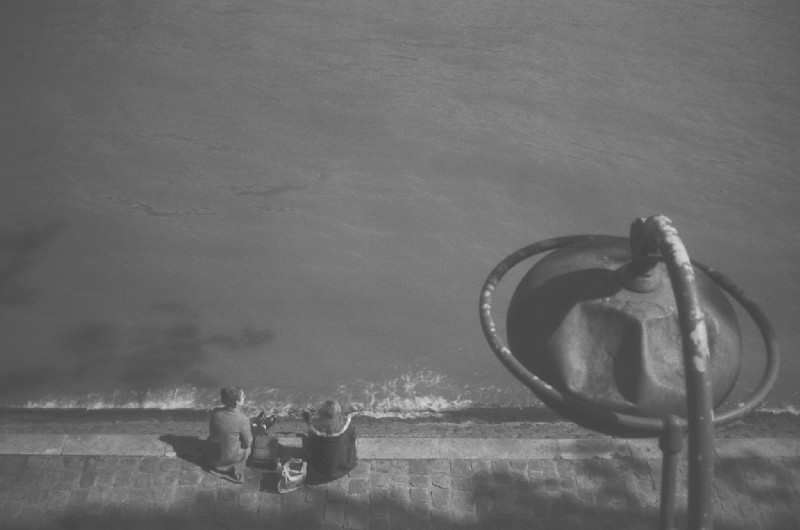
After the first few days of coldness and rain (even the yellow vest protesters didn’t come out on that weekend), there was finally some sunshine on a Monday. I started early, went to the plaza of the Louvre and took some photos and selfies around the Pyramid with all other tourists that didn’t seem interested or brave enough to join the endless queue. I walked from the Louvre to Pont du Carrousel, and from there, watched the remains of the recently burned down Notre Dame from the zoomed-in lens of my iPhone. I crossed the bridge, walked along the other side of the Seine, and was greatly impressed and entertained by the variety of books displayed at those green foldable old bookstalls by the Seine. When I grew bored of that, I went down from one staircase to the riverside and sat on the bank for a while facing the Seine.
I thought of all the romance movies that have featured the Seine in them, from early Woody Allen’s Everyone Says I Love You to Richard Linklater’s Before Sunset to the deadly romantic La Fille Sur Le Pont. I thought of all those evening movie scenes and the ambiguous and flirtatious atmosphere emitted through the glistening river surface in the shade of the moonlight. And as I was sitting there, facing the river in the daylight, the yellowish green water which was hopelessly unphotogenic, I saw with sheer clarity the discrepancy between this world and a romanticized world and my position in between. I didn’t feel disappointed, in fact. I appreciate the wateriness in the truth, as much as I appreciate how much effort our predecessors have made in creating a rose-colored filter for all of us so we could have a better vision of this world.

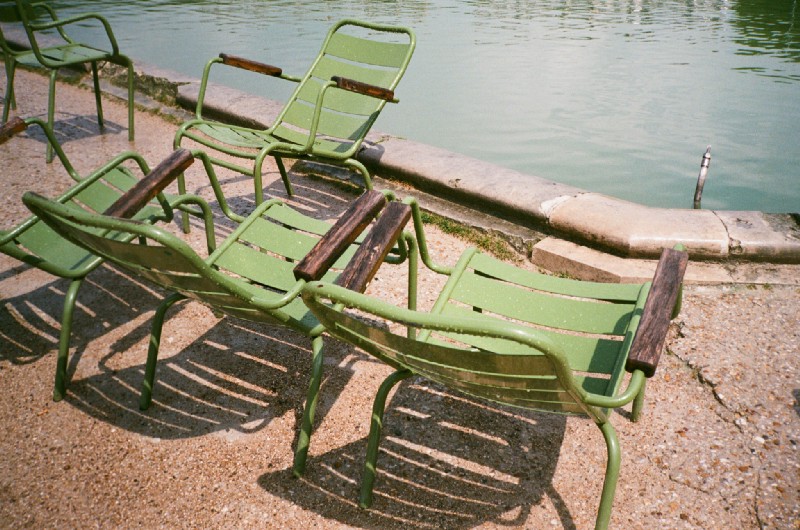
I continued to walk, crossed back to the other side of the river and wandered into Jardin des Tuileries. Everyone in this 17th-century garden seemed eagerly breathing on this bright sunny day. I walked to the fountain and took a seat by it, the kind that let you lean back in a sunbath position. Two seats beside me sat a French old man, feeding biscuits to pigeons. He took some biscuits crumbs from the chest of his jacket and stuck out his palm, waited, in a few seconds some pigeons would come and take it. From time to time even ducks from the fountain pond and crows from the upper sky would come and join the biscuit fete. Not only did he attract birds, but he also attracted tourists. People came close, happily intrigued by how he interacted with his friends with wings and took photos of them. He shared some biscuits with little kids and encouraged them to try.
The old man noticed me as I was filming it and couldn’t help chuckling. I like your shoes, he said. Is there a better opening line than complimenting a girl’s shoes? Life has certainly taught him something, I thought. We started to talk and he told me he had been to China three times. I have a love in China, he said. Is she still your love? He laughed and said, Time passed. But we are still in a good connection. Every year she’d say happy birthday to me. I guess he told me this becoz the fact that I’m Chinese reminded him of his past love. But as we were there, sitting by the pond on a Monday morning, he seemed completely at ease, as if nothing is more important in life than feeding pigeons anymore. I asked him if he came here a lot to feed pigeons. He shook his head. “I came once last month when the weather was good. Yesterday I sat in front of TV the whole day. I don’t worry anymore. I just relax.”
Later that day, after paying a tribute visit to the Effeil Tower (yet not seeing the point) and more art-cramming and time-traveling at Musée de Montmartre, I ended up at Parc de Belleville in the 20th arrondissement to wait for sunset. The 20th is evidently more local a quarter with a heavy hipster and street art vibe. As I arrived at the top of the park with my takeaway wine, I found myself immersed in an agreeable smell of marijuana. I picked a spot on the lawn to settle myself, surrounded by but not too close to other groups of people.
I was perfectly enjoying myself, the 7pm setting sun and the smell of youth, while a homeless-looking Dominican guy came with a broken guitar and sat down two meters from me. He was very likely high on something, eagerly making reckless conversations with people around, especially me. I wasn’t really in the mood of conversing with someone high. Unfortunately, his English is much better than most educated Parisians. More unfortunately, I seemed to be the object he decided to focus on. I wasn’t really responding but he kept speaking to me about stuff, that he is a philosopher, a musician, he writes songs and sings to make a living, he practices a special kind of yoga, he is looking for someone to translate his lyrics into Chinese, he thinks I’m beautiful. My guts told me he wasn’t dangerous, but he still made me a bit nervous. Two young guys sat not too far in front of me. They tried to speak to the Dominican guy in French to divert his attention from me but had limited luck. Another Italian couple on the other side of him then managed to occupy some of his attention, which I felt deeply grateful for. As the sun was slowly setting, the temperature slowly dropping, people were also slowly taking off. When I was getting ready to leave, he said “I’m gonna sing some songs to make some money tonight, probably 70 euro, 80 maybe. I will see.” I didn’t know if he was speaking to himself or me. But out of a rush of curiosity, I asked, where can I hear your music? He seemed to be more awake by then, told me he had only uploaded one song online and taught me how to search for it on Youtube. It’s about a heartbreaking marriage in the past, he said. Most good music is about heartbreaks, I said. I listened to his track that evening and it actually wasn’t bad. At least he was serious about his music, I thought.

On my last full day in Paris, I joined a Write and Wander in Paris experience booked on Airbnb. The experience was led by Sarah, a young French girl with a bookish but pretty face who doesn’t seem to care much about her appearance. She walked with me and another young Argentinian girl around the little-known neighborhood where the Romantic Movement artists gathered in the 19th century, and introduced to us in strong French accent some historical anecdotes of the Romantic Era. From her, I learned how George Sand had an affair with Frédéric Chopin; how Felix Nadar, an iconic pioneer at the very beginning of Photography, took a group of selfies of every angle of himself while one photo would take 30 minutes to make at that time. But what I enjoyed most was still the experimental writing, the creative perspectives she provided for a number of short writing exercises we did throughout the tour. On that morning, with Sarah’s tips and timer, I wrote paragraphs about an imagined internal monologue of Nadar on a postcard, about the ideal Salon scenario in my heart (and thanks to that I decided to throw a small party when I’m back in Hong Kong), about a speech I’d give to my friends at a party I host every Tuesday like people in the Romantic Era, and about nothing but simply automatically write for five minutes without lifting the pen from the paper. I’ve always been very private and protective of my writing process. But on that morning, I felt open and inspired enough to read and share my immature writings with the two young girls with completely different backgrounds and found myself secretly loving it. In some way, it’s the kind of intimate and connected feeling I’ve been missing, the kind that one can only get from spending time with people of similar passions.
In late afternoon that day, I went back to Marais and visited the gallery of the guy who bought me a drink on my first night. He seemed genuinely surprised to see me and showed me around the gallery a bit. It’s a small boutique gallery, but with some interesting works. We had a drink after he closed the gallery and before he had to leave for a theatre show that evening. It was nice in its own awkward way. After that one drink, we walked to République together and said goodbye in front of the metro. As I walked back to my apartment, in hindsight, I realized that was probably the most “French” thing I did in Paris, to randomly connect with someone in a new city and say goodbye in a casual manner without any unnecessary reluctance.
If my personal opinion matters to the slightest degree, Paris is great, it’s all I ever imagined, and perhaps even better in reality. When I was walking in Paris, I found myself couldn’t help wondering, would I really wanna live here? As much as I enjoy almost every moment in Paris (and even the cold rainy days, the compromised communications, the rude metro coordinator and the airport taxi driver that tried to con me didn’t impair my fondness of this city), it’s after all a reality I can’t truly relate to. I dare not to forget I was a visitor to the city. All my perspectives, my experience, my emotions and my attachments, only exist from the identity of a visitor. No matter how happy Paris has made me, it’s the kind of happiness that lacks a bit of weight.
Paris might not be my reality. Maybe it never will be, maybe it never is supposed to be. Though I think I do have taken a piece of Paris back with me. Like Hemingway said, “if you’re lucky enough to have lived in Paris as a young man, then wherever you go for the rest of your life, it stays with you.” I guess in my discounted version, I could always look back at my Instagram stories and tell myself, “We’ll always have Paris.”

「Short Story」Alone in Kyoto

The nights in Kyoto always feel longer than they are, and the daytime shorter. I don’t know why, maybe it’s the season; I’m always here in late autumn, this time too. I usually start to feel a bit anxious around 5 pm, when the blueness in the sky starts to darken, worrying about how to spend the night, and where. There aren’t many options for a woman travelling alone. There is only one, really: drinking at a bar. Bars are one thing this town will never be short of. But just like anywhere else, finding one that is friendly and safe enough is still not the easiest thing. It isn’t quite true what I said back there — I’m not travelling here, at least, sightseeing is not why I came. I’m just staying for a little while, wanting to be alone.
It’s never easy to be alone, and it gets particularly awkward on vacation. But, somehow, it’s still easier than being with people, at least for someone like me. I don’t remember exactly how it happened, whether it’s that I chose to be a loner, or that I didn’t really have any choice. But there I was, sitting at this bar alone, a cozy little place close to my guesthouse. It was 8 pm. I had picked the bar from Google Maps, praying that it wouldn’t be too bad. And it wasn’t bad. It certainly wasn’t fancy, with a dart board, a TV screen showing irrelevant sports that no one was paying attention to, and some musical instruments scattered carelessly in one corner. Everything was wooden — the bar table, the cabinets, the stools — which made it feel old-fashioned, and I liked it. I’ve had enough modernness at the bars in my own city; the oldness here reminded me that I was in a completely different space. An outsider, alone and free.
The bar was in the northern part of the city, quite far away from the touristy blocks, and was evidently a neighbourhood bar, where customers were mostly locals and regulars. I sensed that the first second I walked in, and felt grateful that the bartender simply gave me a casual glance, without showing any extra attention to make me feel more out of place than I already was. So there I was, sitting at the very end of the long bar table, in a corner spot that gave me a clear view of the whole place but would also help me shy away from excessive attentions. It’d be a lie to say that I didn’t want any attention; I don’t think there’s a woman in the world who doesn’t want any attention at all. But I’ve certainly passed the age when any kind of attention is welcome.
The bartender was a middle-aged Japanese guy, dressed relatively formally for a bartender, with a suit vest, a bow tie, and a casquette. It seems to be a custom in Japan, that people in the service industry always dressed formally, as if making a statement that they are doing a respectable job, even if you’re paying.
What would you like to drink? The bartender asked. I, as usual, couldn’t make up my mind and nothing from the menu looked convincing enough. Sensing my hesitation, the bartender said he could make me something off-menu, if I told him what my preferences were. What are my preferences, that was an even trickier question. I never know what are my preferences, with my drink, with a lot of other things in life. But I do have an answer prepared for this kind of question, as someone who goes to bars quite often. Whiskey based, citrusy, not too sweet, not in a martini glass, I said.
There were not many people in the bar, three or four groups of guests, including me. There was a young couple who looked like they could be university students, sitting in the middle of the room, at the bar, I tried not to look at them too obviously. But it was hard to completely ignore them either. In one way, their existence helped ease my self-consciousness about being a solo woman in the bar, while in another, they made it worse.
I lit up a cigarette while waiting for my drink, a habitual attempt to appear slightly more occupied. Out of the corner of my eye, I could see the young couple enjoying each other’s company, talking and laughing from time to time, rubbing against each other when they moved their bodies as they laughed. They looked happy, at least at the moment. They probably didn’t know yet that happiness could be fleeting. I had been happy too, from time to time in the past two years, when I was with Leon. But that had ended. The relationship, the happiness. The happiness earlier than the relationship. I refocused on my cigarette, as if smoking it needed my full attention. I dragged my mind back from thinking of the breakup. Not yet, I told myself.
The bartender attempted to make casual conversation. I didn’t mind it that much. He seemed like someone who knew how to keep the right distance. He probably just felt obligated to make me feel less alone. Through the talk, I learned that he had owned and managed the bar by himself for 20 years. He had a wife and two daughters, but running the bar made his schedule quite the opposite of the typical family man’s. The official close time on Google Maps was 1 am, but he’d only close the bar when the last customer had left, which meant usually 2–3 am, sometimes later. I went home at 7 am this morning, he said. I could tell he was enjoying his life this way; maybe he was enjoying it too much. I almost felt sorry for his wife. She must either love him a lot or have a lover, I thought. As a woman, no matter how differently you identify, you just can’t help putting yourself in the same shoes as another woman.
I was two thirds down on my first drink. I looked at my phone: 8:40 pm. The conversation with the bartender was happening on and off. Most of the time he was talking in Japanese with other customers, but sometimes he’d walk over to my end of the bar and use his limited English to ask me something, the standard questions you’d ask a traveller — I started to feel grateful that he kept talking to me, which made me feel less of an awkward being and, more importantly, less lonely. I was slowly getting tipsy, feeling looser, but not yet loose enough to completely shake off the sense of being an intruder in this space, to this crowd.
I thought of how I used to feel like an intruder in a lot of other situations, when I had to meet and hang out with Leon’s friends, on occasions full of his social crowd, the creative, artsy, funky, party crowd. I thought of the constant uneasiness and slight embarrassment that I had to endure all those times, being new to everyone and, more importantly, being a perpetual outsider to that circle. That was something that didn’t ever change, no matter how many times I showed up at those occasions — showing up enough times didn’t make me an insider, just a familiar-looking outsider; and showing up enough times didn’t make me anyone’s friend, I’d always be “that girl”, Leon’s girlfriend. When I thought of the suffocating sense of subordination throughout the relationship, the feeling of always playing a part that I didn’t even audition for, a mixture of anger and aversion filled up my chest, followed by thick relief. I was so grateful to be alone now, at a random Kyoto bar. It felt more real than all those parties I went to with Leon. It was more real.
I finished my first drink and ordered another one. The bar was getting busier. Apparently there would be a band playing a live gig from 9:30 pm; they were setting up at the little corner stage at the other end of the bar from me. The university puppy-love couple was joined by more university puppy-love couples. A middle-aged man in a suit came in. Just back from a business trip from Osaka, I gathered from what he told the bartender. He was apparently a regular. It was a pretty young clientele overall. The music was getting up. I lit another cigarette. I was switched on to the “party of one” mode now, and I decided to stay longer.
The bartender seemed happy that I was staying. He talked more to me, but always with the polite distance that he seemed to be constantly reminding himself to keep from his customers. It made me feel comfortable, and feel more open to conversation, even though it wasn’t easy with his limited choice of English words.
I sipped slowly at my second drink, looking at my phone from time to time, alternating between my screen and my cigarettes. A man came in and sat on the only vacant seat left beside me. The bar was now full of young happy loud innocent Japanese souls as the university band had started their jazz gig. The new guy looked stuck out in this crowd — his overly hipster style was slightly unmatched with his age, which was hard to guess, as if he was trying to conceal his ageing process behind his clothes. He had wild curly hair, casually tied back, and was wearing some unnecessary and garish accessories. His face was marginally handsome, with facial features suggesting he wasn’t completely Japanese. When you’re alone, you have the capacity to analyze everything around you. He rolled up his sleeves the moment he sat down, immediately ordered a beer in Japanese, and eagerly started to make conversation with the bartender, indicating that he was an acquaintance. He seemed determined to not even glance at me, which contradicted the frivolous vibe he was emitting, and intrigued me slightly. Men usually look at me at bars. I expect to be looked at, at least once or twice, sometimes more shamelessly than others, like the way Leon did on the night we met.
I still vaguely enjoy revisiting the anecdote of how we met. I was completely wasted at the end of a disastrous night, having had a huge fight with someone, and went back to a party where there was no one I knew left. I was drifting around the dance floor, using my last flicker of consciousness to gauge if there was any reason that I should stay. Just then, I felt this gaze fixated on me, almost burning. At first, just like this man sitting beside me at the bar now, I was determined not to look back. I was half enjoying the gaze, half annoyed by the audacity of it. This didn’t last long before I felt it was too much, and casually looked back — there he was, this fairly tall guy with a natural elegance wearing a white turtleneck. I met his gaze, which, surprisingly, didn’t feel offensive or intruding or filled with lust, but more like an honest appreciation mixed with a mild concern. I certainly must have looked very lost and drunk. I walked over to him and said, This is not the way to look at a girl. He said, I don’t care. He came home with me that morning. And that was the very beginning of things.
The bartender became too busy to stay in the conversion with his acquaintance customer or to entertain me, and left us, two individual clients on their own, squeezed at the very end of the bar, both seeming slightly out of place relative to the rest of the crowd. When I was not contemplating my own thoughts, I could feel the faint awkwardness between the two of us. I could also feel that he could feel it too. It was hard to say who started to talk first, probably me rather than him, but then again maybe both of us at the same time, thanks to the effectiveness of alcohol. Either way, we started to make snatchy conversation, like two people in a movie might do, when they happened to sit side by side at a bar .
He was indeed, of mixed heritage with blood from Japan, Italy, America and France. He spoke fluent English with an unidentifiable accent, which made the conversation surreally smooth for a Japanese setting. He ran a pizzeria with a guesthouse upstairs. He was 29, married two years ago to a Japanese woman five years older than him. They met in Tokyo when he was a party boy and moved to Kyoto together to start this family business with his Italian father. Wasn’t that quite early to get married for a guy like you? I lightly joked. I’ve had my fair share of fun let’s say, he answered, and since my wife is older she felt the urgency of marriage for her age, and it just happened. I didn’t poke more into it, even though his commitment level didn’t sound convincing. He bought a round of shots for me and the bartender to drink together. A night out by himself in a bar like this was not that usual for him now, but he had just had a bad day and needed a drink, he said. As we talked, his phone rang several times; he picked up the first two times, answered in Japanese and ignored the rest. I told my wife I will go home in 40 minutes, he said, as though making an announcement, while ordering another drink for himself. Both the bartender and I laughed. I grew more willing to talk as I kept consuming more alcohol. I laughed at every funny and not-that-funny comment he made. It felt good to be entertained, or at least to appear so. It felt easier to laugh there by myself, with a random guy I’d never see again in this life, than it has been to laugh at those parties I went to with Leon and his friends. I felt free, free to laugh, free to drink, free to just be myself, not affiliated, not attached.
So how does it happen that a woman like you is drinking here by yourself? The pizzeria guy asked, just like any other guy would. I didn’t intend to be therapized tonight, while I also had no reason to not be truth-telling to a complete random stranger. I enjoyed having the power to tell or not tell. I decided to tell as much as I felt like. But where did I even start?
It’s just my thing, I travel alone.
No boyfriend?
No. Not at this moment.
How come? A beautiful woman like you should have plenty of options.
I felt slightly offended and, more to the point, disappointed, at this typical patriarchal mentality, as if a woman’s value can only be validated by the companionship of someone with a penis. I was not there to preach political correctness to someone who tried to solve his own issues with marriage and was not even aware of it; I was there to enjoy myself. I shrugged it off.
Do I really have plenty of options? Maybe I do. In a world like this, anyone can have plenty of options, enabled by technology and demoralizing apps. But the thing is, having too many options feels just the same as having no options. We are the generation so deeply confused by options. What good are options if you fail to follow through with any of them anyway? I started to feel the guilt burning in my chest and my brain again, together with a wave of sadness and anger. What have I done with my options? Other than hurting, getting hurt, and hurting? I hate people telling me I have options, it’s almost like a silent accusation implying that I should have done better with all my options, like they are the one to judge. I’d rather someone just rip the bandaid off it and tell me outright: “You fucked up.”
When I had just met Leon, I thought he might be The One. It isn’t easy to feel that way again when you’re in your 30s. It was intense. Everything just felt so “right” that it made me want to cry. That kind of feeling. One time in the early days, when we were both lying in bed, I asked Leon if he thought we’d always be this happy. He said of course, and that if one day we became not-happy, we’d find a way to be this happy again. It was one of those moments when I thought to myself, That’s probably the most romantic thing I’ve ever heard, and managed, for just one second, to let go of my fundamental skepticism of all good things. Until one day it seemed we were spending more time fighting than snuggling. I grew needier and more demanding, as I usually did, while feeling more suffocated and burdened in the relationship. A room with no window, a tug of war. I slept with someone else. Leon found out. He stormed out of my apartment and out of us. That was it. How easily things got ruined. How cliché a story it is to tell. I finished my third or fourth drink. The pizzeria guy ordered another round for us; I was not counting anymore. It’s funny when you think how the initial thought at the beginning of a relationship plays a part in the whole thing after it’s over. In this case, the thought that I’ve met The One is like a joke I play on myself, a magnifier of an inevitable disappointment.
The band was ending their gig with the song Can’t Take My Eyes off You, invoking an innocent, upbeat vibe that was too contagious to ignore.
You’re just too good be true
I can’t take my eyes off you
You’d be like heaven to touch
I wanna hold you so much
……
I love you baby
And if it’s quite all right
I need you baby
To warm the lonely nights
I love you baby
Trust in me when I say
……
People love to hear songs about love, no matter how banal they are. Everyone in the bar was laughing senselessly, facilitated by alcohol and popular jazz tunes. I could be happy too, I thought. I am. How bizarre it is it to be feeling happy now, when just a moment ago I was recalling my broken relationship. How shortly people dwell on each other these days. The harder I tried to remember the feeling with Leon, the blurrier everything became. All those happy memories, like that summer road trip in southern France, they all seemed less real than drinking alone in a random Kyoto bar.
You know what, you can have any men you want, if you really want them, but it’s too easy, it’s not enough for you. You’re too smart for your own good. After a night of drunken chatting, the pizzeria guy threw his diagnosis at me. I looked at him in the eyes. What he wanted from me was so obvious. He was right, it was too easy. He had even turned off his phone in the past hour, so there were no more angry-wife calls to bother him. And I was too drunk to even care.
The bar was quieting down, the crowd gradually leaving, and only the most determined guests stayed. The pizzeria guy was smashed — he’d probably had 10 drinks at least, a mix of beer, cocktails and shots. He was not making much sense with whatever he was saying, to me or to the bartender. He was getting more audacious in his attempts to bring sex into the conversation. But he simply looked too drunk to be seriously offensive or flirtatious. He made me feel sad, and a bit unsafe to be sitting next to him now. The bartender seemed to have sensed my discomfort and mouth-apologized, I’m sorry, he whispered behind the bar, and took away the pizzeria guy’s empty glass. The two of them conversed in Japanese for a bit, the pizzeria guy nodding vigorously yet senselessly. He didn’t seem to be in full control of his movement anymore. Out of the blue he gave me a kiss on the side of my forehead and told me he was leaving.
It is my pleasure tonight. You’re really too smart for your own good. I hope you’d be a happier person. He said.
I hope you won’t be in trouble when you get home. I said.
It’s usually easier to be concerned about other people’s problems. It helps you forget about your own. I felt tranquilized on my seat for a while after the pizzeria guy left. An emptiness came upon me. It was 1:50 am. I asked for the bill. It’s all settled, the bartender said, by the pizzeria guy. I was confused about what to feel at that particular moment other than genuinely surprised. Should I be glad, or should I feel bad? It must have been a big bill. I thought of how he told me business was not good at the guesthouse, with platforms like airbnb disrupting the market. I felt bad, puzzled even. What was he trying to convey?
I changed my mind about leaving and decided to stay on, out of an unexplainable urge to spend some of my own money to pay for my own drinks. Maybe out of a need to restore the balance, or I was just too wasted to make smarter decisions. My head was spinning. Another new cocktail was served. The bartender was still apologetic for the drunk pizzeria guy’s behavior, as though he’d been harassing me or something. I kept telling him that it was ok, that I was ok. I’ve been through worse, of course. Comparatively speaking, this was nothing: he had merely been urging me to drink more than I would by myself and tried to discuss my sexual behavior. There were way worse things a man could do to a woman when he was drunk.
The bar was really empty now, just me, the bartender, another middle-aged Japanese guy who seemed to be a regular, and a young couple, of which the boy worked part-time at the bar. They were talking casually, and even when they were speaking Japanese I could tell that all they were talking about were subjects of no real importance. From time to time they tried to include me by switching to English and, in my compromised sobriety, I just let it flow. Apparently they’d end their nights like this quite often. For a moment, I felt like one of them, like I belonged there, like this was also how I often ended my nights: drinking alone, feeling both addicted and irrelevant. I became so fond of this imagined closeness that I started to dread how it would end. The bartender was talking about how he sometimes liked to get some udon after he closed the bar on his way home, and then how there was a high risk of reproducing mini-udon when they were all puked out because he’d be super drunk. Everyone laughed at the mini-udon joke. I could tell this was a joke he told often to entertain his guests, especially those who lasted till the end. I laughed and laughed, sometimes without even knowing what I was laughing about, as if once I’d decide to be entertained, everything becomes amusing. At some point, I thought I briefly lost consciousness. What was keeping me awake was really just a need to uphold a minimal level of dignity as a single female tourist. A woman should never be too drunk to walk herself home, not ever, not to mention in a foreign city.
I wouldn’t mind having some udon now, I said, half-jokingly, feeling a sudden craving. Are you sure? We can order some now, the bartender said. The idea seemed to be welcomed by the Japanese group. The bartender picked up his phone to make an order. In twenty minutes or so, a delivery guy arrived with five bowls of udon. Everyone was already focusing on their own bowl of udon before I realized what was going on. I thought some food was supposed to drag me back to the conscious side, at least a little bit, while indeed, I hadn’t felt more dislocated the whole evening than at this moment. I could feel my last surviving sobriety floating off my body, emitting a message that read “eating udon in a bar with four Japanese strangers at 5 am — better remember this moment.” Just at that second, as I was sending more udon into my mouth with a pair of chopsticks, an unstoppable rush of nausea seized me and I badly needed to vomit. I tried my best to keep calm, stood up from my stool and walked slowly to the restroom, trying to avoid any sudden movements that might make me vomit on the way. I locked the door and, almost at the same second, before I had time to aim properly, I vomited all over the bathroom. There they were, the mini-udons, everywhere.
I felt suddenly fully awake, my consciousness automatically resumed in the face of a mini-udon crisis. I can’t walk out leaving a mess like this, I thought. It’d be too indecent. I grabbed the roll toilet paper and started to wipe off the mini-udons, the floor, the wall, the toilet seat, the rim of the toilet. When the toilet paper in my hand was full of mini-udons, I flushed it down the toilet, and started over again with more toilet paper. I did that for I don’t know how long, maybe half hour, maybe longer; I’d lost all sense of time. I don’t believe I’ve ever cleaned a toilet so hard in my whole life. I have always hated housework, and yet there I was, cleaning my own vomit in a random bar in Kyoto at 5 am. I didn’t know what to feel. I wanted to cry but didn’t have time. There was an urgency more pressing than all others, the urgency to clean all these fucking mini-udons. I was almost amused by the situation, but I didn’t feel like laughing. I would be curious to see my facial expression at that particular moment, if it had been caught on camera. But there was nothing, there was no one, there was only me. Me and my mini-udon mess. No one ought to know about this.
I walked out of the bathroom trying to look innocent. Everyone looked at me in a concerned way. Are you ok? The bartender asked earnestly. I must have been in there too long. I told him that I was ok, but I didn’t think I could finish the udon. Everyone looked so tired. The sky was lightening, from dark blue to a paler shade. A new day had arrived. Now that I had vomited up everything and regained some sobriety, I could no longer ignore the absurdity of this evening. I felt a wave of self-loathing. Why didn’t I leave at a more sensible time? Why couldn’t I leave at a more sensible time? I’ve always had problems leaving a party, and Leon was the same. Our whole encounter might not have happened if not for our shared anxiety of leaving the party. You don’t really enjoy staying, you’re mad at yourself for not being able to have fun, you force yourself into fun by over-boozing, you think you are having fun because you’re drunk enough, you let it all go and slide into an altered reality. That reality lasts a while but then the booze effect starts to diminish and you find yourself stuck in a middle land, you know it’s about to end but you’re dreading the end so you keep forcing it and forcing it and forcing it, until some greater external force makes the decision for you that you should have made a long time ago. The break of dawn, the encounter with someone, the mini-udons.
I guessed that was it. I paid my bill, thanked the bartender and said my goodbyes. I dislike saying goodbyes. I wish I could do them less awkwardly.
It was a five-minute walk back to my guesthouse. When I came out onto the street, the autumn chill brushed over my face. In the morning twilight, everything appeared gentle, indifferent to my existence. The world seemed to have lost its gravity. I felt exhausted, and relieved. Now, I just couldn’t wait to go back to my room, gargle, lie in the bed curled into a ball and finally, with daylight, go to sleep. It’s only loneliness, after all. Many must have it.
 A clean, well-lighted place.