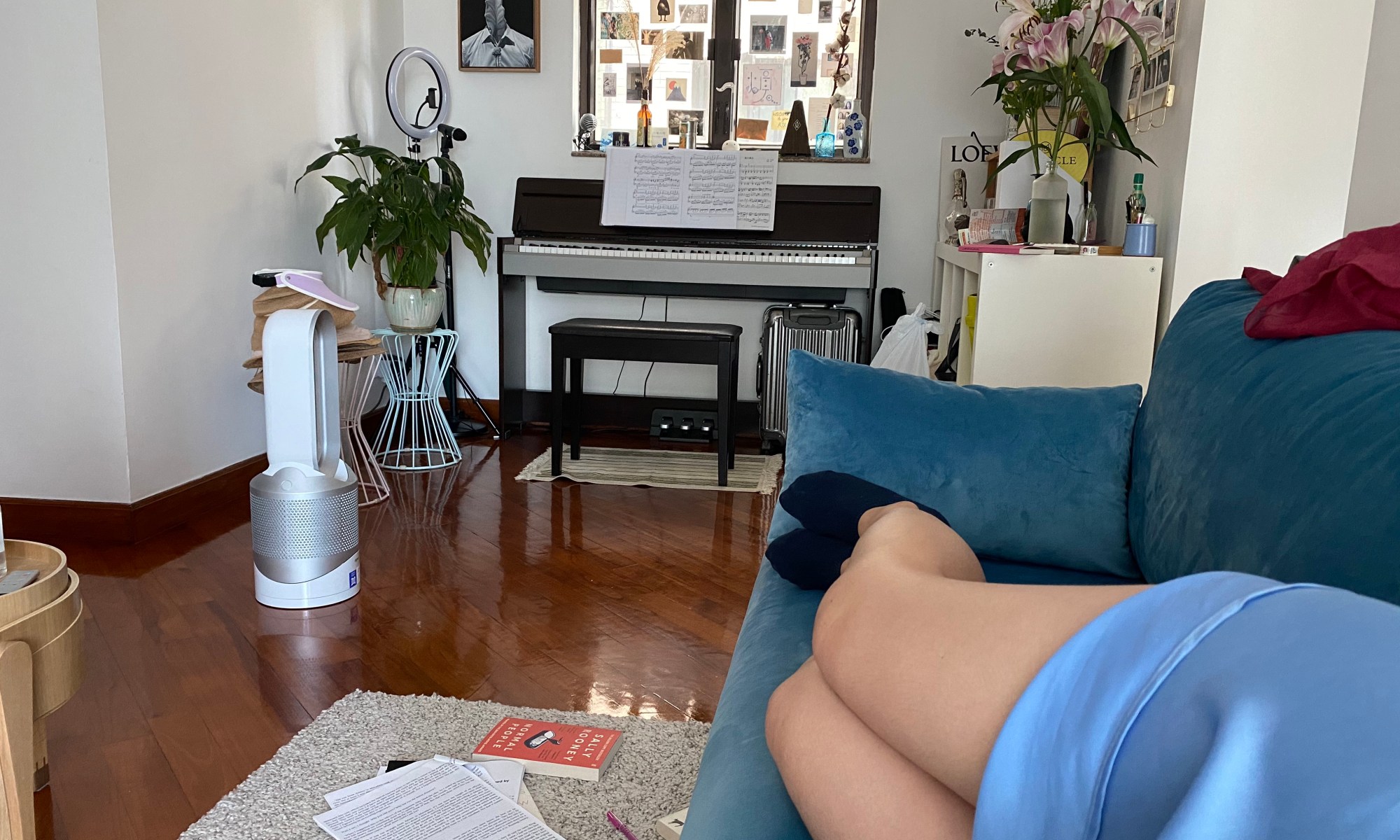
To write, or to retreat.

Just recently I took a 7-day holiday using some of my annual leaves to stay home and write, or a writing retreat, as I call it.

The idea was to withdraw from the routine activities and all worldly connections and take an intensive period of time to focus on writing. I had a clear quantifiable goal in my mind: to finish a short story in 7 days. The result was, I finished the story as early as day 4 and managed to write something more. I was 100% in my own world, stayed out of contact with the outside world, lived a strict and healthy daily schedule, and wrote a little more than 10,000 words. I was quite satisfied with what I have accomplished. But to some extent, that didn’t matter that much anymore afterward. It’s the process that seems more like an accomplishment to me than the story itself. I was feeling something substantial from it, as if I was finally able to connect with a missing piece within myself. When I was going through that 7 days, I knew I’d have to write about it, for no other purpose than to create text evidence of what I have felt. I could tell, it’s something too important to be forgotten.

I started to develop this idea a few months ago. After I was back from Sri Lanka in Feb, I realized traveling probably wouldn’t be an option for a long time. It’s devastating for me, who takes travel as a mental commodity. As the virus spread, my hope of breaking out was dimmer day after another and I knew I’d need to create a holiday that doesn’t involve traveling.

Last year I spent 6 days disconnected in a silent retreat and it was a truly restorative time. My heart was lingering over that for a long time afterward and I secretly decided I’d do it once a year from then. Apparently, it doesn’t look possible now. So I thought, why not recreate that experience at home myself? I was very excited but also slightly scared by this idea.

You must be a little crazy to even think about it. And yet, I have learned to accept my own neuroticism and try my best to indulge it. After the crazy has developed the idea, it’s the rational half of me that had to do her job and started to gauge the possibility of pulling this off. In a silent retreat facility, everything was taken care of. I had food, nature, enough activities and service at my fingertips; all I needed to do was to enjoy all that. At home, I’d need to take care of my own 3 meals a day, arrange my own activities, and resist the distraction in a wifi-enabled small apartment right in the busiest city in the world.

I did quite a lot in planning — I learned a diet which required minimal effort, prepared necessary ingredients and planned a rough schedule of replenishment; I set up an hourly schedule from 6 am to 10 pm to make sure I always have a behavioral compass and wouldn’t end up wasting my time; I carefully arranged how to stay connected in a way I can listen to music and research for my writing while also resist the rest of internet; I made a list of entertainment options, from piano to cooking, from bubble bath to pedicure (I even bought the toolkit for that, but ended up having no time at all for such things). But after all these, until the last moment, I still didn’t know if it was enough planning and if I was really all set for it. After all, it’s not something I have any experience with nor there are existing well-documented references I can look to. It feels like jumping into a well without knowing where is the bottom.

Then I gave myself the final green card: It’s ok if I failed to finish the story. After all, it’s supposed to be a holiday, and I’m supposed to enjoy it. With this re-adjusted mentality, I started my 7-day solo trip as usual. Just that this time, it’s a trip in my mind.

My days went like this. I’d get up at 6 (though I’d usually snooze for 30 mins to one hour…getting up early is really not my forte), have coffee, and meditate 15 minutes with flowing music to slowly wake up in the first half-hour. Then I’d shower and have a simple breakfast. Oatmeal, blueberries, or some convenient packaged milkshake. In the beginning, I didn’t wanna spend too much time on food preparation before I develop a rough idea of my writing rhythm and progressing speed.

Then I’d focus on writing from 8:30 to 12. The story I was writing is one I already have started with during a trip last year but could never find time to finish in the past year. So I more or less knew what I wanted to write, with a fair amount of draft notes to refer to. It was more about putting my mind to it and doing the actual labor work. When it comes to creative writing, or painting, or any kind of art creation, I constantly wonder which is the heavy-lifting part, having the idea itself or executing the idea. I guess it varies for different people and they are equally important for the final work. But this time, I’m glad I mostly only needed to focus on the latter. In some way, I see it as the more challenging part coz writing in a second language usually requires extra effort to get it right, and that is assuming I have what it takes to get it right.

From 12 to 2 are lunch and nap. I’d usually have some carb for lunch — dumplings, fried rice, one dish and steamed rice, etc. Miraculously, without too much thought on it, I managed to do different things for lunch every day. And instead of watching one episode of something on Netflix (as I always do when I eat), I’d listen to music and read Murakami’s essays as I ate. Theoretically, watching Netflix doesn’t break any rules. But I particularly wanted to avoid doing things in my old routine and develop a new routine largely centered around texts and music, the tone I’ve preset for this break.

Murakami’s essay is the perfect light reading for this purpose. It’s never too engaging in a way that it diverts you off the track you’re on, (in this case, is to finish my lunch in a sensible time) while it also makes everything you’re doing seem automatically more purposeful and enjoyable. I love Murakami’s essays, probably even more than his novels. In this break, I re-read his memoir < What I talk about when I talk about running> one more time. In a way, I was purposefully seeking out that calming power in the tone of his essays, which always refreshes and comforts my mind.

Then I’d try to nap for 20 mins or so before I resumed writing in the afternoon from 2 to 6. Throughout the whole time, I’d play light jazz or piano tunes to just have some music flowing in the back of my head. Most of the time, it was either Thelonious Monk or Miles Davis. I selected the music for the same criteria as my reading — something not too engaging but effectively constructs the vibe that I was in need of — classy, delightful, and tranquilizing.

I tried to stop writing at 6 sharp, regardless of how the progress was going. Previously, when I was writing some essays on the weekend, I barely made any effort to keep track of time. I’d continue until I reached a point where either I was finished or I was too exhausted. Often, when I reached that point, I had been typing in a completely dark apartment for hours and it had way passed the sensible hour to eat or sleep. Evidently, that’s not good writing habit and I was determined to change that this time. Hemingway once said you don’t write until you’ve exhausted the last drip, even tho that’s counterintuitive; you always stop when there’s still something left in the fountain so you have enough to start with the next day. I like how sensible it sounds. Though for me, with creative writing, I don’t even think I have that fountain yet. It’s more like I was still restlessly drilling for it with every word I wrote. Indeed, it wasn’t too hard to stop at a designated time.

I’d then do some light exercise as the day transitions into the evening. I alternated between running on a treadmill for 20mins and swimming for 1500 meters. One day, I did fast-walking for an hour along the seafront for a change. Both walking and swimming are very good exercise to keep an active thinking process going. I’d usually take this time to go over some details in my story: is everything on the right track, how to address some specific bits, do I wanna include or exclude some materials, how much progress am I supposed to make next day, etc. It’s rather technical mostly, but sometimes it can get a little emotional too when I really go deep in. Running, on the other hand, is still too painful for me to have any meaningful thoughts simultaneously. I wonder if the day will come that I’d have a sudden surge in my tolerance with the act of running after enough attempts. It feels quite unlikely.

Dinner was always the same — chicken salad. I prepared enough chicken for 7 days and put them in the freezer. So every day it took only 15 mins to make the salad, and that was my most relaxed time of the day. I’d put on happier/funkier music and improvise some hideous dance moves as I was chopping vegetables in the kitchen. Then I’d eat at my coffee table sitting on the rug — my multi-functional station and primitive position in the apartment — with something to read. I picked some random issues of New Yorkers from my hardcopy stash over the years and read the short stories in them. I guess this is one good thing about having print subscriptions — you can’t really do it this way with a digital-only subscription. When I got tired of reading, I just lay back at the edge of my sofa and stared at the ceiling for a short break, with food still in my mouth and music in my ears. It was the moment I repetitively fell in love with, the solid contentment from spending the whole day exactly the way I wanted, with all sorts of things that I find pleasure doing, including the intermittent idleness.

After dinner, I’d play the piano for half an hour or longer. In fact, I played the piano in bits and pieces anytime I want during the day, even writing hours. I was working on a song that I want to do a video with so making slow progress at that did give me a concrete sense of satisfaction. If writing the story is the main dish of the day, playing the piano is the coffee, something equally important that I don’t do without.

I’d move to bed before 10 and write a quick journal in bed, updating my word count log, summarizing my day and jotting down some observations, whatever came to my mind at that moment. At this point, I must say I was usually already exhausted and couldn’t wait to go to bed; I could barely hold my pen straight and my handwriting became hardly recognizable to myself. I thought of how Murakami said writing is more a labor work than a mind work and realized full-time writing, which was more or less I was trying to do, is indeed both a challenge to my mind (in terms of focus level) and my physical strength. I don’t even know why I was so tired. I could fall asleep in five seconds.

When I try to reflect on what this week means to me, what is the “substantial” thing that I felt, it comes to my realization that it’s probably the first time in a long time in my adulthood that I know for sure I wasn’t just frittering away my life. Instead, I lived it precisely how I want it with a clear sense of purpose and a conscious effort directed towards that purpose. Unlike when one was younger, a lot of “purposes” were planted into our minds or we acquired them through external influences, the purpose this time comes solely from within.

For years, I was trapped in a powerless mindset about this purpose, of being a writer, to just write, with no specific agendas. When asked about what’s the thing that I wanna do most, or what’s my dream job, I’d always tell people I’d like to be a writer (a financially free one). I remember one ex-boyfriend asked me this question quite early in our volatile relationship. He was also the first and only one who judged/caught me outright:” You keep saying your passion is writing but I don’t see you doing anything about it at all. “ His words hit me quite hard, I must say, partly coz I knew he was right. I wasn’t doing anything about writing other than talking about it. I was too trapped/preoccupied in the stupid worldly life that I feared touching on the one thing that I love. I thought, what’s the point if I can’t afford to dedicate all my time to it and I’m probably not as talented as I think I was? For years, I had a very unhealthy relationship with writing.

From last year, I bought this domain and started to write more regularly here, this little unreserved private space. In the past year or so I gradually overcame the uneasiness I had with writing, and this 7-day retreat feels like a mirror from a parallel future — it helps me see in sheer clarity what kind of life I could be living and what kind of person I could be one day. I enjoyed every moment of it and I adored the person I briefly was in those 7 days. It happened so quickly and left me with a writer’s blue when I was back in my full-time job the next day, the job that actually pays. But deep down I know, just a transitory taste of it is already worth it.

As I’m writing this, a plain moment from years ago came back to me. I was with the just-mentioned ex-boyfriend and we were having a quick breakfast in a cafe and talking casually. He randomly said, you know, if you really wanna be a writer, I can support you for one year and you just do your writing thing, so at least you have that one year to try it out and see if it’s really your thing. I must have laughed it off at that time, probably a little amused by the fact that he was even offering, as what he was making could barely support his own passion. Thinking back, knowing perfectly it was just a casual remark, I wonder if that’s indeed the most romantic thing anyone has ever said to me. Not becoz I’m moved that someone wanted to provide for me, but that he was the only person who took my writing dream more serious than myself.

If this 7-day writing retreat serves any purpose, I think, it reassures me that with enough effort, a lot of things are possible. It’s possible to take a meaningful vacation without flying. It’s possible to go ahead to do something even though it’s not something people would normally do. And it’s possible to keep trying — talented or not — with the best one can afford. Maybe a year, maybe 7 days.

「Short Story」Alone in Kyoto


The nights in Kyoto always feel longer than they are, and the daytime shorter. I don’t know why, maybe it’s the season; I’m always here in late autumn, this time too. I usually start to feel a bit anxious around 5 pm, when the blueness in the sky starts to darken, worrying about how to spend the night, and where. There aren’t many options for a woman travelling alone. There is only one, really: drinking at a bar. Bars are one thing this town will never be short of. But just like anywhere else, finding one that is friendly and safe enough is still not the easiest thing. It isn’t quite true what I said back there — I’m not travelling here, at least, sightseeing is not why I came. I’m just staying for a little while, wanting to be alone.

It’s never easy to be alone, and it gets particularly awkward on vacation. But, somehow, it’s still easier than being with people, at least for someone like me. I don’t remember exactly how it happened, whether it’s that I chose to be a loner, or that I didn’t really have any choice. But there I was, sitting at this bar alone, a cozy little place close to my guesthouse. It was 8 pm. I had picked the bar from Google Maps, praying that it wouldn’t be too bad. And it wasn’t bad. It certainly wasn’t fancy, with a dart board, a TV screen showing irrelevant sports that no one was paying attention to, and some musical instruments scattered carelessly in one corner. Everything was wooden — the bar table, the cabinets, the stools — which made it feel old-fashioned, and I liked it. I’ve had enough modernness at the bars in my own city; the oldness here reminded me that I was in a completely different space. An outsider, alone and free.

The bar was in the northern part of the city, quite far away from the touristy blocks, and was evidently a neighbourhood bar, where customers were mostly locals and regulars. I sensed that the first second I walked in, and felt grateful that the bartender simply gave me a casual glance, without showing any extra attention to make me feel more out of place than I already was. So there I was, sitting at the very end of the long bar table, in a corner spot that gave me a clear view of the whole place but would also help me shy away from excessive attentions. It’d be a lie to say that I didn’t want any attention; I don’t think there’s a woman in the world who doesn’t want any attention at all. But I’ve certainly passed the age when any kind of attention is welcome.

The bartender was a middle-aged Japanese guy, dressed relatively formally for a bartender, with a suit vest, a bow tie, and a casquette. It seems to be a custom in Japan, that people in the service industry always dressed formally, as if making a statement that they are doing a respectable job, even if you’re paying.

What would you like to drink? The bartender asked. I, as usual, couldn’t make up my mind and nothing from the menu looked convincing enough. Sensing my hesitation, the bartender said he could make me something off-menu, if I told him what my preferences were. What are my preferences, that was an even trickier question. I never know what are my preferences, with my drink, with a lot of other things in life. But I do have an answer prepared for this kind of question, as someone who goes to bars quite often. Whiskey based, citrusy, not too sweet, not in a martini glass, I said.

There were not many people in the bar, three or four groups of guests, including me. There was a young couple who looked like they could be university students, sitting in the middle of the room, at the bar, I tried not to look at them too obviously. But it was hard to completely ignore them either. In one way, their existence helped ease my self-consciousness about being a solo woman in the bar, while in another, they made it worse.

I lit up a cigarette while waiting for my drink, a habitual attempt to appear slightly more occupied. Out of the corner of my eye, I could see the young couple enjoying each other’s company, talking and laughing from time to time, rubbing against each other when they moved their bodies as they laughed. They looked happy, at least at the moment. They probably didn’t know yet that happiness could be fleeting. I had been happy too, from time to time in the past two years, when I was with Leon. But that had ended. The relationship, the happiness. The happiness earlier than the relationship. I refocused on my cigarette, as if smoking it needed my full attention. I dragged my mind back from thinking of the breakup. Not yet, I told myself.

The bartender attempted to make casual conversation. I didn’t mind it that much. He seemed like someone who knew how to keep the right distance. He probably just felt obligated to make me feel less alone. Through the talk, I learned that he had owned and managed the bar by himself for 20 years. He had a wife and two daughters, but running the bar made his schedule quite the opposite of the typical family man’s. The official close time on Google Maps was 1 am, but he’d only close the bar when the last customer had left, which meant usually 2–3 am, sometimes later. I went home at 7 am this morning, he said. I could tell he was enjoying his life this way; maybe he was enjoying it too much. I almost felt sorry for his wife. She must either love him a lot or have a lover, I thought. As a woman, no matter how differently you identify, you just can’t help putting yourself in the same shoes as another woman.

I was two thirds down on my first drink. I looked at my phone: 8:40 pm. The conversation with the bartender was happening on and off. Most of the time he was talking in Japanese with other customers, but sometimes he’d walk over to my end of the bar and use his limited English to ask me something, the standard questions you’d ask a traveller — I started to feel grateful that he kept talking to me, which made me feel less of an awkward being and, more importantly, less lonely. I was slowly getting tipsy, feeling looser, but not yet loose enough to completely shake off the sense of being an intruder in this space, to this crowd.

I thought of how I used to feel like an intruder in a lot of other situations, when I had to meet and hang out with Leon’s friends, on occasions full of his social crowd, the creative, artsy, funky, party crowd. I thought of the constant uneasiness and slight embarrassment that I had to endure all those times, being new to everyone and, more importantly, being a perpetual outsider to that circle. That was something that didn’t ever change, no matter how many times I showed up at those occasions — showing up enough times didn’t make me an insider, just a familiar-looking outsider; and showing up enough times didn’t make me anyone’s friend, I’d always be “that girl”, Leon’s girlfriend. When I thought of the suffocating sense of subordination throughout the relationship, the feeling of always playing a part that I didn’t even audition for, a mixture of anger and aversion filled up my chest, followed by thick relief. I was so grateful to be alone now, at a random Kyoto bar. It felt more real than all those parties I went to with Leon. It was more real.

I finished my first drink and ordered another one. The bar was getting busier. Apparently there would be a band playing a live gig from 9:30 pm; they were setting up at the little corner stage at the other end of the bar from me. The university puppy-love couple was joined by more university puppy-love couples. A middle-aged man in a suit came in. Just back from a business trip from Osaka, I gathered from what he told the bartender. He was apparently a regular. It was a pretty young clientele overall. The music was getting up. I lit another cigarette. I was switched on to the “party of one” mode now, and I decided to stay longer.

The bartender seemed happy that I was staying. He talked more to me, but always with the polite distance that he seemed to be constantly reminding himself to keep from his customers. It made me feel comfortable, and feel more open to conversation, even though it wasn’t easy with his limited choice of English words.

I sipped slowly at my second drink, looking at my phone from time to time, alternating between my screen and my cigarettes. A man came in and sat on the only vacant seat left beside me. The bar was now full of young happy loud innocent Japanese souls as the university band had started their jazz gig. The new guy looked stuck out in this crowd — his overly hipster style was slightly unmatched with his age, which was hard to guess, as if he was trying to conceal his ageing process behind his clothes. He had wild curly hair, casually tied back, and was wearing some unnecessary and garish accessories. His face was marginally handsome, with facial features suggesting he wasn’t completely Japanese. When you’re alone, you have the capacity to analyze everything around you. He rolled up his sleeves the moment he sat down, immediately ordered a beer in Japanese, and eagerly started to make conversation with the bartender, indicating that he was an acquaintance. He seemed determined to not even glance at me, which contradicted the frivolous vibe he was emitting, and intrigued me slightly. Men usually look at me at bars. I expect to be looked at, at least once or twice, sometimes more shamelessly than others, like the way Leon did on the night we met.

I still vaguely enjoy revisiting the anecdote of how we met. I was completely wasted at the end of a disastrous night, having had a huge fight with someone, and went back to a party where there was no one I knew left. I was drifting around the dance floor, using my last flicker of consciousness to gauge if there was any reason that I should stay. Just then, I felt this gaze fixated on me, almost burning. At first, just like this man sitting beside me at the bar now, I was determined not to look back. I was half enjoying the gaze, half annoyed by the audacity of it. This didn’t last long before I felt it was too much, and casually looked back — there he was, this fairly tall guy with a natural elegance wearing a white turtleneck. I met his gaze, which, surprisingly, didn’t feel offensive or intruding or filled with lust, but more like an honest appreciation mixed with a mild concern. I certainly must have looked very lost and drunk. I walked over to him and said, This is not the way to look at a girl. He said, I don’t care. He came home with me that morning. And that was the very beginning of things.

The bartender became too busy to stay in the conversion with his acquaintance customer or to entertain me, and left us, two individual clients on their own, squeezed at the very end of the bar, both seeming slightly out of place relative to the rest of the crowd. When I was not contemplating my own thoughts, I could feel the faint awkwardness between the two of us. I could also feel that he could feel it too. It was hard to say who started to talk first, probably me rather than him, but then again maybe both of us at the same time, thanks to the effectiveness of alcohol. Either way, we started to make snatchy conversation, like two people in a movie might do, when they happened to sit side by side at a bar .

He was indeed, of mixed heritage with blood from Japan, Italy, America and France. He spoke fluent English with an unidentifiable accent, which made the conversation surreally smooth for a Japanese setting. He ran a pizzeria with a guesthouse upstairs. He was 29, married two years ago to a Japanese woman five years older than him. They met in Tokyo when he was a party boy and moved to Kyoto together to start this family business with his Italian father. Wasn’t that quite early to get married for a guy like you? I lightly joked. I’ve had my fair share of fun let’s say, he answered, and since my wife is older she felt the urgency of marriage for her age, and it just happened. I didn’t poke more into it, even though his commitment level didn’t sound convincing. He bought a round of shots for me and the bartender to drink together. A night out by himself in a bar like this was not that usual for him now, but he had just had a bad day and needed a drink, he said. As we talked, his phone rang several times; he picked up the first two times, answered in Japanese and ignored the rest. I told my wife I will go home in 40 minutes, he said, as though making an announcement, while ordering another drink for himself. Both the bartender and I laughed. I grew more willing to talk as I kept consuming more alcohol. I laughed at every funny and not-that-funny comment he made. It felt good to be entertained, or at least to appear so. It felt easier to laugh there by myself, with a random guy I’d never see again in this life, than it has been to laugh at those parties I went to with Leon and his friends. I felt free, free to laugh, free to drink, free to just be myself, not affiliated, not attached.

So how does it happen that a woman like you is drinking here by yourself? The pizzeria guy asked, just like any other guy would. I didn’t intend to be therapized tonight, while I also had no reason to not be truth-telling to a complete random stranger. I enjoyed having the power to tell or not tell. I decided to tell as much as I felt like. But where did I even start?

It’s just my thing, I travel alone.

No boyfriend?

No. Not at this moment.

How come? A beautiful woman like you should have plenty of options.

I felt slightly offended and, more to the point, disappointed, at this typical patriarchal mentality, as if a woman’s value can only be validated by the companionship of someone with a penis. I was not there to preach political correctness to someone who tried to solve his own issues with marriage and was not even aware of it; I was there to enjoy myself. I shrugged it off.

Do I really have plenty of options? Maybe I do. In a world like this, anyone can have plenty of options, enabled by technology and demoralizing apps. But the thing is, having too many options feels just the same as having no options. We are the generation so deeply confused by options. What good are options if you fail to follow through with any of them anyway? I started to feel the guilt burning in my chest and my brain again, together with a wave of sadness and anger. What have I done with my options? Other than hurting, getting hurt, and hurting? I hate people telling me I have options, it’s almost like a silent accusation implying that I should have done better with all my options, like they are the one to judge. I’d rather someone just rip the bandaid off it and tell me outright: “You fucked up.”

When I had just met Leon, I thought he might be The One. It isn’t easy to feel that way again when you’re in your 30s. It was intense. Everything just felt so “right” that it made me want to cry. That kind of feeling. One time in the early days, when we were both lying in bed, I asked Leon if he thought we’d always be this happy. He said of course, and that if one day we became not-happy, we’d find a way to be this happy again. It was one of those moments when I thought to myself, That’s probably the most romantic thing I’ve ever heard, and managed, for just one second, to let go of my fundamental skepticism of all good things. Until one day it seemed we were spending more time fighting than snuggling. I grew needier and more demanding, as I usually did, while feeling more suffocated and burdened in the relationship. A room with no window, a tug of war. I slept with someone else. Leon found out. He stormed out of my apartment and out of us. That was it. How easily things got ruined. How cliché a story it is to tell. I finished my third or fourth drink. The pizzeria guy ordered another round for us; I was not counting anymore. It’s funny when you think how the initial thought at the beginning of a relationship plays a part in the whole thing after it’s over. In this case, the thought that I’ve met The One is like a joke I play on myself, a magnifier of an inevitable disappointment.

The band was ending their gig with the song Can’t Take My Eyes off You, invoking an innocent, upbeat vibe that was too contagious to ignore.

You’re just too good be true

I can’t take my eyes off you

You’d be like heaven to touch

I wanna hold you so much

……

I love you baby

And if it’s quite all right

I need you baby

To warm the lonely nights

I love you baby

Trust in me when I say

……

People love to hear songs about love, no matter how banal they are. Everyone in the bar was laughing senselessly, facilitated by alcohol and popular jazz tunes. I could be happy too, I thought. I am. How bizarre it is it to be feeling happy now, when just a moment ago I was recalling my broken relationship. How shortly people dwell on each other these days. The harder I tried to remember the feeling with Leon, the blurrier everything became. All those happy memories, like that summer road trip in southern France, they all seemed less real than drinking alone in a random Kyoto bar.

You know what, you can have any men you want, if you really want them, but it’s too easy, it’s not enough for you. You’re too smart for your own good. After a night of drunken chatting, the pizzeria guy threw his diagnosis at me. I looked at him in the eyes. What he wanted from me was so obvious. He was right, it was too easy. He had even turned off his phone in the past hour, so there were no more angry-wife calls to bother him. And I was too drunk to even care.

The bar was quieting down, the crowd gradually leaving, and only the most determined guests stayed. The pizzeria guy was smashed — he’d probably had 10 drinks at least, a mix of beer, cocktails and shots. He was not making much sense with whatever he was saying, to me or to the bartender. He was getting more audacious in his attempts to bring sex into the conversation. But he simply looked too drunk to be seriously offensive or flirtatious. He made me feel sad, and a bit unsafe to be sitting next to him now. The bartender seemed to have sensed my discomfort and mouth-apologized, I’m sorry, he whispered behind the bar, and took away the pizzeria guy’s empty glass. The two of them conversed in Japanese for a bit, the pizzeria guy nodding vigorously yet senselessly. He didn’t seem to be in full control of his movement anymore. Out of the blue he gave me a kiss on the side of my forehead and told me he was leaving.

It is my pleasure tonight. You’re really too smart for your own good. I hope you’d be a happier person. He said.

I hope you won’t be in trouble when you get home. I said.

It’s usually easier to be concerned about other people’s problems. It helps you forget about your own. I felt tranquilized on my seat for a while after the pizzeria guy left. An emptiness came upon me. It was 1:50 am. I asked for the bill. It’s all settled, the bartender said, by the pizzeria guy. I was confused about what to feel at that particular moment other than genuinely surprised. Should I be glad, or should I feel bad? It must have been a big bill. I thought of how he told me business was not good at the guesthouse, with platforms like airbnb disrupting the market. I felt bad, puzzled even. What was he trying to convey?

I changed my mind about leaving and decided to stay on, out of an unexplainable urge to spend some of my own money to pay for my own drinks. Maybe out of a need to restore the balance, or I was just too wasted to make smarter decisions. My head was spinning. Another new cocktail was served. The bartender was still apologetic for the drunk pizzeria guy’s behavior, as though he’d been harassing me or something. I kept telling him that it was ok, that I was ok. I’ve been through worse, of course. Comparatively speaking, this was nothing: he had merely been urging me to drink more than I would by myself and tried to discuss my sexual behavior. There were way worse things a man could do to a woman when he was drunk.

The bar was really empty now, just me, the bartender, another middle-aged Japanese guy who seemed to be a regular, and a young couple, of which the boy worked part-time at the bar. They were talking casually, and even when they were speaking Japanese I could tell that all they were talking about were subjects of no real importance. From time to time they tried to include me by switching to English and, in my compromised sobriety, I just let it flow. Apparently they’d end their nights like this quite often. For a moment, I felt like one of them, like I belonged there, like this was also how I often ended my nights: drinking alone, feeling both addicted and irrelevant. I became so fond of this imagined closeness that I started to dread how it would end. The bartender was talking about how he sometimes liked to get some udon after he closed the bar on his way home, and then how there was a high risk of reproducing mini-udon when they were all puked out because he’d be super drunk. Everyone laughed at the mini-udon joke. I could tell this was a joke he told often to entertain his guests, especially those who lasted till the end. I laughed and laughed, sometimes without even knowing what I was laughing about, as if once I’d decide to be entertained, everything becomes amusing. At some point, I thought I briefly lost consciousness. What was keeping me awake was really just a need to uphold a minimal level of dignity as a single female tourist. A woman should never be too drunk to walk herself home, not ever, not to mention in a foreign city.

I wouldn’t mind having some udon now, I said, half-jokingly, feeling a sudden craving. Are you sure? We can order some now, the bartender said. The idea seemed to be welcomed by the Japanese group. The bartender picked up his phone to make an order. In twenty minutes or so, a delivery guy arrived with five bowls of udon. Everyone was already focusing on their own bowl of udon before I realized what was going on. I thought some food was supposed to drag me back to the conscious side, at least a little bit, while indeed, I hadn’t felt more dislocated the whole evening than at this moment. I could feel my last surviving sobriety floating off my body, emitting a message that read “eating udon in a bar with four Japanese strangers at 5 am — better remember this moment.” Just at that second, as I was sending more udon into my mouth with a pair of chopsticks, an unstoppable rush of nausea seized me and I badly needed to vomit. I tried my best to keep calm, stood up from my stool and walked slowly to the restroom, trying to avoid any sudden movements that might make me vomit on the way. I locked the door and, almost at the same second, before I had time to aim properly, I vomited all over the bathroom. There they were, the mini-udons, everywhere.

I felt suddenly fully awake, my consciousness automatically resumed in the face of a mini-udon crisis. I can’t walk out leaving a mess like this, I thought. It’d be too indecent. I grabbed the roll toilet paper and started to wipe off the mini-udons, the floor, the wall, the toilet seat, the rim of the toilet. When the toilet paper in my hand was full of mini-udons, I flushed it down the toilet, and started over again with more toilet paper. I did that for I don’t know how long, maybe half hour, maybe longer; I’d lost all sense of time. I don’t believe I’ve ever cleaned a toilet so hard in my whole life. I have always hated housework, and yet there I was, cleaning my own vomit in a random bar in Kyoto at 5 am. I didn’t know what to feel. I wanted to cry but didn’t have time. There was an urgency more pressing than all others, the urgency to clean all these fucking mini-udons. I was almost amused by the situation, but I didn’t feel like laughing. I would be curious to see my facial expression at that particular moment, if it had been caught on camera. But there was nothing, there was no one, there was only me. Me and my mini-udon mess. No one ought to know about this.

I walked out of the bathroom trying to look innocent. Everyone looked at me in a concerned way. Are you ok? The bartender asked earnestly. I must have been in there too long. I told him that I was ok, but I didn’t think I could finish the udon. Everyone looked so tired. The sky was lightening, from dark blue to a paler shade. A new day had arrived. Now that I had vomited up everything and regained some sobriety, I could no longer ignore the absurdity of this evening. I felt a wave of self-loathing. Why didn’t I leave at a more sensible time? Why couldn’t I leave at a more sensible time? I’ve always had problems leaving a party, and Leon was the same. Our whole encounter might not have happened if not for our shared anxiety of leaving the party. You don’t really enjoy staying, you’re mad at yourself for not being able to have fun, you force yourself into fun by over-boozing, you think you are having fun because you’re drunk enough, you let it all go and slide into an altered reality. That reality lasts a while but then the booze effect starts to diminish and you find yourself stuck in a middle land, you know it’s about to end but you’re dreading the end so you keep forcing it and forcing it and forcing it, until some greater external force makes the decision for you that you should have made a long time ago. The break of dawn, the encounter with someone, the mini-udons.

I guessed that was it. I paid my bill, thanked the bartender and said my goodbyes. I dislike saying goodbyes. I wish I could do them less awkwardly.

It was a five-minute walk back to my guesthouse. When I came out onto the street, the autumn chill brushed over my face. In the morning twilight, everything appeared gentle, indifferent to my existence. The world seemed to have lost its gravity. I felt exhausted, and relieved. Now, I just couldn’t wait to go back to my room, gargle, lie in the bed curled into a ball and finally, with daylight, go to sleep. It’s only loneliness, after all. Many must have it.

Experience and hope: a 30-year-old little girl


I turned 30 a few days ago.

If I may disclose a public secret — being 30 feels exactly like being 29, just like being 29 felt exactly like being 28…I don’t need to go on. But I can’t deny that the imaginary threshold is working on me, like an itchiness at the back of my brain, a phone ringing in the midnight that you’d eventually have to pick up — I can’t help thinking what does 30 years’ life mean, if it means anything at all, and what kind of existence should a 30-year-old person stand for.

I’ve always been a pessimist. And I had all these peculiar beliefs that I held on to firmly when I was little. For example, since I started to form the minimal level of independent thoughts (ie. mid-primary school), I had been telling everyone around me that “I’m going to die before 30.” I was so certain of it for 2 reasons: 1, I couldn’t bear to even imagine I would be a 30-year-old woman one day — it simply sounded dreadful. I didn’t consider how exactly I would die (apparently I thought I would have loads of time to work out a plan) if it doesn’t happen naturally, I just knew I had to; 2, I thought 30 years was more than enough to live — in my young immature mind, everything I ever wanted to experience (eg, being able to go to bed as late as I want; being able to watch TV as much as I want; having a job I like and getting paid, having a boyfriend and sweet love, etc) would definitely happen before 30 and everything afterwards would just be repetitive boredom.

The other this kind of bold and “laughable” statements I’ve made also include: I will never get married. (coz i don’t believe in it — the concept is too perfect for imperfect human beings); I will never have kids. (coz I can’t bring myself to pass the underlying pain of life to another person while I couldn’t even convince myself my life is worth living. The whole deal of giving birth — creating life for the enjoyment of oneself or whatever other selfish reasons — makes little sense to me.)

As I am 30 now, I guess this is the first time “things go against wish” for the younger self of me and her assertive pledges — I have disappointed her, by turning 30. I almost feel sorry, while at the same time, I, as the 30-year-old present self, take it quite well. It even feels like a pleasant surprise — having lived for 30 years in this world trapped in this body is, in my own standard, quite an achievement, no matter if it felt like one or not.

So what kind of 30-year-old person am I? (deep breathe.) I guess it’s time to do a reality check. (/damage assessment)

  • I have no savings (at all).
  • I am a property owner in paper thanks to Chinese parenting and I’m very much in debt (only 29.3 years left).
  • I am single, with baggages, inevitably.
  • I have a job, one that numbs my soul and pays the bills.
  • I have been living in a city I dislike for 12 years.
  • I have identity crisis. Being culturally marginalized for almost half my time, I barely have any sense of attribution to any cities I’ve lived. I’m rather detached political-wise and the priority level of my mother language is fading in my brain.
  • I have an estranged relationship with my parents, who still treat me like I’m 15 and incapable of living my life. It unsettles me when I try to imagine the discrepancy between the daughter in their mind and who I really am.
  • I am self-diagnosed as sociopath and misanthropist. My sense of socialness is decreasing and it’s almost impossible for me to make new friends. Obsessed with deep, intimate and intellectually equal connections, I find it unbearable to carry most casual conversations with general acquaintances.
  • I started to see a therapist a while ago when I sensed symptoms of depression.
  • I am evidently not a happy person. (But even for me it takes some courage to admit that.)

Obviously I can’t say I’m at my prime state at this point of my life, but if I’m being fair to myself, I would say I’m not a terrible person, even faintly likable, with a certain quaintness; I’m definitely not dull, somewhat intelligent, and I don’t believe my life is on the boring side on a scale of interestingness. I’ve always known myself as an experience-driven person, and I did experience things, even tho I never went out of my way to seek for them. Thinking back, my experience portfolio is probably the only thing I unquestionably possess.

But don’t get it wrong — when one is at my age (now I’m starting to sound like I’m 30), one should have realized that experiences are not always valuable, not even for someone who lives on experiences like me.

Of course I have had many nice experiences, ones that at some point did convince me my life is worth living just to have that. The moments of falling in love, even with the most impossible persons; the girl history, without which I wouldn’t know first-hand the existence of spectrum and the possibilities in sexuality; the places travelled, roads walked, people encountered, the ultimate excitement of doing something adventurous as a solo traveller; the day I got my first and only tattoo; the sweet moments in relationships like when he knelt down to help me redo my shoelace; the evening of my best friend’s wedding and the MOH speech I had to get myself half-drunk to deliver; the years working in the newsroom and the primitive satisfaction despite of the realistic limitations and being poorly paid; the sparkling and witty conversations on a breezy night with someone like-minded that made me feel like I was in Woody Allen’s movie; the shivering in heart when greatly moved by cinematography, literature, architecture and art; the perfect state of mind briefly found in Kyoto; the late night picnic by an abandoned reservoir overseen by a sky of stars, the rainy getaway weekend on a local touristy island, the psychedelic camping on a remote beach, the rooftop sex, and all the crazy and romantic situationist love-making.

Then there were those experiences that only served the purpose of opening your eyes, those you don’t mind but probably wouldn’t wanna have again. The drugs, the bad trip, the ridiculous parties and clubs, the threesome, the junk boat, the motorbike accident in the middle of nowhere in Thailand, the moment of lying in my own blood and not sure how alive I was, the ultimate fear and loneliness.

Then there were those that you secretly wish they never happened. The cheating that ended my first relationship and damaged my trust system. The cheating that ended my last relationship and the continuous suffering from the guilt and remorse even two years after the breakup. The alcoholism of an ex-boyfriend. The afternoon of being sexually assaulted in primary school, which I subconsciously chose to forget for the whole childhood and only remembered it years into adulthood. The phase of being sexually confused and lost. The dark passage of self-decadency. The illness. The dreadful moment of getting a call of “bad news” and the horrible 24 hours before I found it out. The demoralizing days that I had to force myself to face treatments, surgeries, medical reports and expensive hospital bills. The embarrassment of dragging myself to SLAA meeting, sitting with a bunch of random strangers and realizing knowing there’re people like me or even more fucked up does not help.

I can’t bother to even try to be comprehensive and logical when I disorderly list out my experiences, and there must be a lot others hidden in the shadow along the memory lane. But I do wonder if these will all flash up at the moment before I die like what people always said — your whole life playing like a fast-forwarding movie in 30 seconds, a condensed capsule to give you a conclusive push.

The thing is, even though I’m dealing with my complexities and polarities, trying to neutralize the self-loathing that evades frequently, when I think about it hypothetically yet seriously, I still wouldn’t say I’d rather swap my life with another kind given the chance — not because I am narcissistic in nature (though it may be factual), but that I wouldn’t be able to imagine who on earth I am if I had never experienced all the pains and struggles, love and hurt. I am tamed by my personal history, my 30-year-long life. I’ve come far enough that I wouldn’t even intend to live differently from scratch, not to mention that I can’t.

For a long time I thought finding happiness is the goal of life, and wanting normal happiness is a humble wish. If there’s anything I could say based on my 30 years’ life, I’d say that is perhaps a bit too aggressive for my kind. I still hope for happiness, unmistakably, but I have also come to the realization that attaining happiness could be beyond my reach,while making peace with pain is less far-reaching.

30 years in life, you’d have realized it’s time to let go of the “wished self” and deal with the “status-quo self”; it’s time to let go of the “wished life” and deal with the “status-quo” life. 30 years in life, you’d have realized life has never been so cruelly real the way it is now, and even more, it had actually been so cruelly real all the time without you noticing; you’d feel like you have a lot to catch up in terms of the realness and you might feel tired already just by thinking of what’s waiting ahead, but it’d also give you a sense of relief, that life, is unavoidably happening. 30 years in life, you’d see it’s not about trying to decide what kind of life you want anymore, it’s only about remembering to breathe, living it, being it, it’s about putting yourself on the spot, giving it out, taking care of every trivial detail wholeheartedly, and praying that it would not be as terrifying as it seems. 30 years in life, I’m still not quite sure what this is about, if there is any meaning, why am I here, but one thing is affirmative, life itself has creepingly convinced me to stay longer than I ever planned, with everything it has put me through.

I do still have a vision of myself, however vague it is. I will still be cool, even tho being cool is not important to me anymore. I will be able to love unreservedly again and it will be worth it despite of everything. I will do a few things I’m proud of, out of the daily banality. I will experience more and hopefully I will know how to contain it better. I will deal with more pain and I will be a stronger person by then. My boldest guess of life — I might even be a mother one day, and if it happens I will be able to tell him/her: “You’re a wanted child, you are here for a reason.”And of course, I will let them know what a miracle it is for a girl who used to only want to live for no more than 30 years.