My dear friend,
How is life? It might sound less than sincere to ask that when knowing there’s no way I could get a timely, substantial reply. But I guess every letter has to start somewhere, and I wish to not start from rambling about my own life, which, as you might already know, is what the rest of this letter will be about.
I took a whole week off at the beginning of April, of which, four days were spent screen-free. It could be seen as a latest, renewed attempt to replicate my experience of a short stay at a silent retreat two years ago – the previous of such attempt was documented here – but I guess this time, I see it less as a “challenge”, but a “self-indulgence”.
I wish I could relay in a precise way what I had gone through in the four days. But I don’t have that level of confidence in my writing, at this moment, as those days seem so distant already, even though they were only two weeks ago. So I think I will share some (selected) texts I’ve journaled out as I was in it. Although they might read dull and messy, they should at least offer some irreplaceable authenticity.
I’d try not to change/rewrite anything in this process of transcription/quick translation, if I could help it. I might, however, make some minor edits where I find it necessary, to facilitate understanding by an external reader.
April 2, 2021 (Day 2)

I didn't realize I've reached the end of this notebook when I was looking for some notebook to journal with and found this. I also didn't realize it's until April that I think of journaling for the first time this year. The first 3 months of 2021 happened like an eye blink. Yesterday I thought of the last time I met with xx (a female friend), which felt like an event just happened not long ago, but at a detailed reflection it was actually end of last year.

The distorted sense of time and the increasingly blurred memories, even of something relatively recent, reminds me of the importance of journaling. Even though, at the end, it might as well just be another attempt in vain to grasp anything at all. It is, at most, a conscious effort to offset, or to counter-balance, to sustain, the transitory nature of everything.

Who would read all my journals? Sometimes I'd think about it - probably not even myself. But I can't deny there's some comfort in doing it. And there's an intrinsic urgency/obligation to do it that I can't be blind to. It shows a genuine effort of being true to one's self. I hope.

It's been two years since I started with this notebook. I have a special fondness for this notebook, particularly becoz of the situation of the first time I wrote on it. It was such a precious and beautiful moment, alone, that I always feel a warmth every time I think of it. Oh, the magical power of Paris.

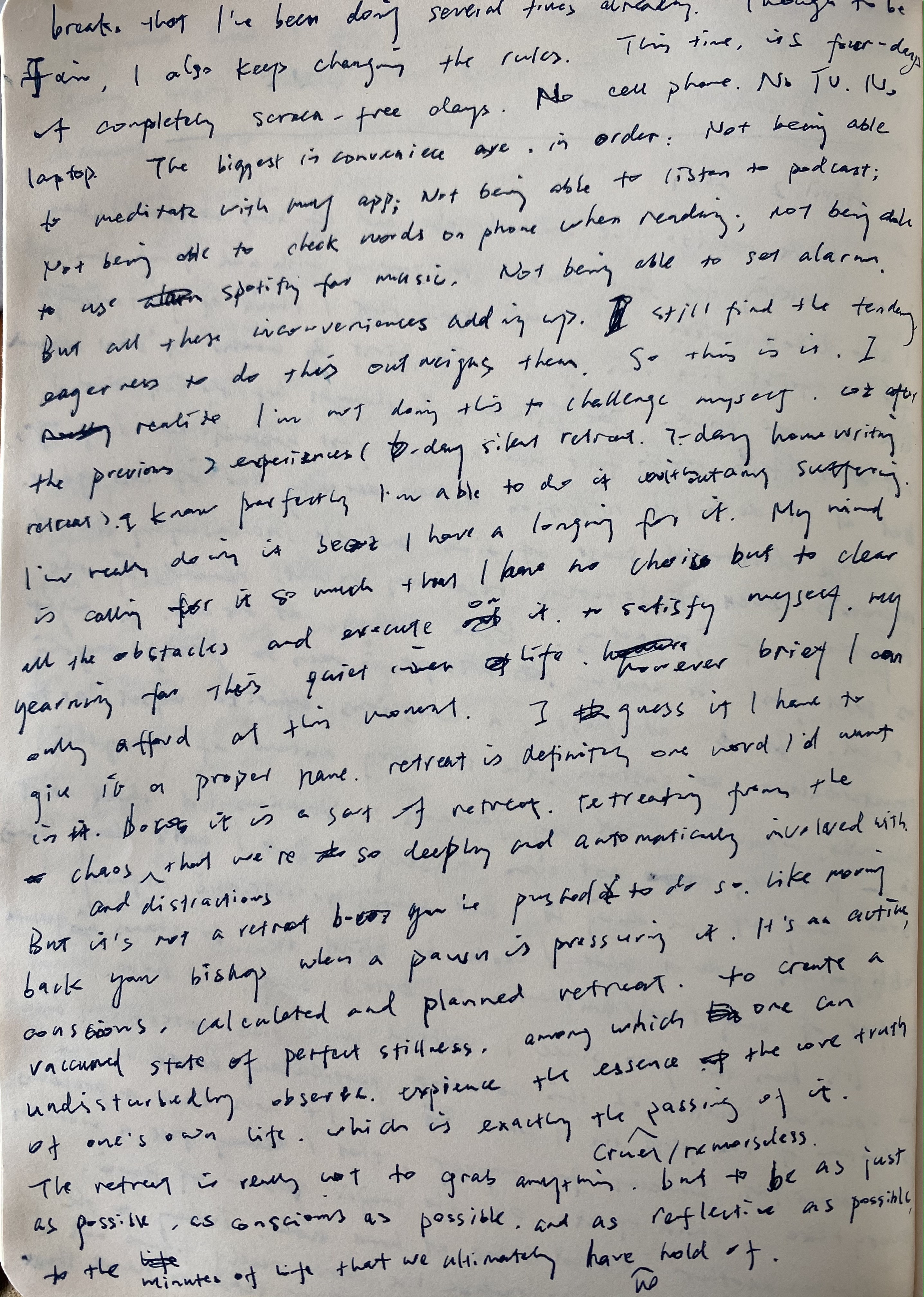
I'm on another isolated break at home now. Today is the second day. I realize I've never really figured out a proper term to name these breaks, that I've been doing several times already. Though to be fair, I also keep changing the rules. This time, it's four completely screen-free days. No cell phone. No TV. No laptop. The biggest inconveniences are, in order: not being able to meditate with my app; not being able to listen to podcasts; not being able to check words on the phone when reading; no being able to use Spotify for music; not being able to set alarm. But all these inconveniences adding up, I still find the eagerness to do this outweighs them all. So this is it.

I realize I'm not doing this to challenge myself (anymore), coz after the previous experiences, I know perfectly I'm able to do it without any suffering. I'm really doing it becoz I have a longing for it. My mind is calling for it so much that I have no choice but to clear all the obstacles and yield to it - a yearning for this quiet inner life - however brief I can afford at this moment. I guess if I have to give it a proper name, retreat is definitely one word I'd have in it. Becoz it is a sort of retreat - from the chaos and distractions that we're so deeply and mechanically involved with. But it's not a retreat becoz one is pushed to do so, like moving back one's bishop when it's pressured by a pawn. It's an active, conscious, calculated and planned retreat, to create a vacuumed state of perfect stillness, among which one can undisturbedly observe, and live the essence/core truth of one's own being, which is exactly the passing of it.

The retreat is really not to grab anything, but to be as just as possible, as conscious as possible, and as reflective as possible, to the minutes of life that one ultimately has no hold of.

There's nothing we can really grasp in life, but it's also a great blissed liberty to choose the particular way of not grasping.

10pm:  I went out after dinner (cabonara) to look for moon, but she was nowhere to be found.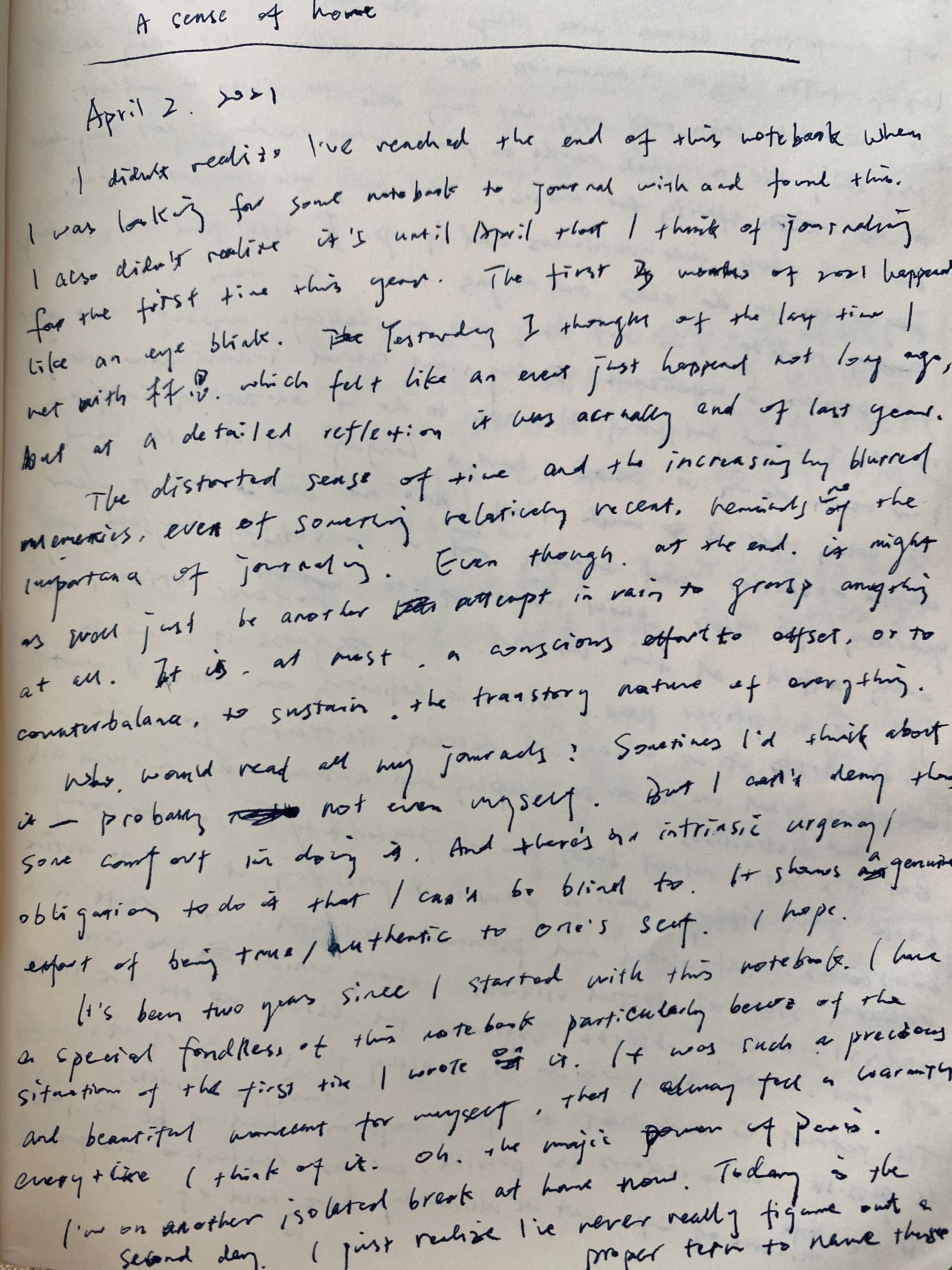
April 3, 2021 (Day 3)
7:30am:
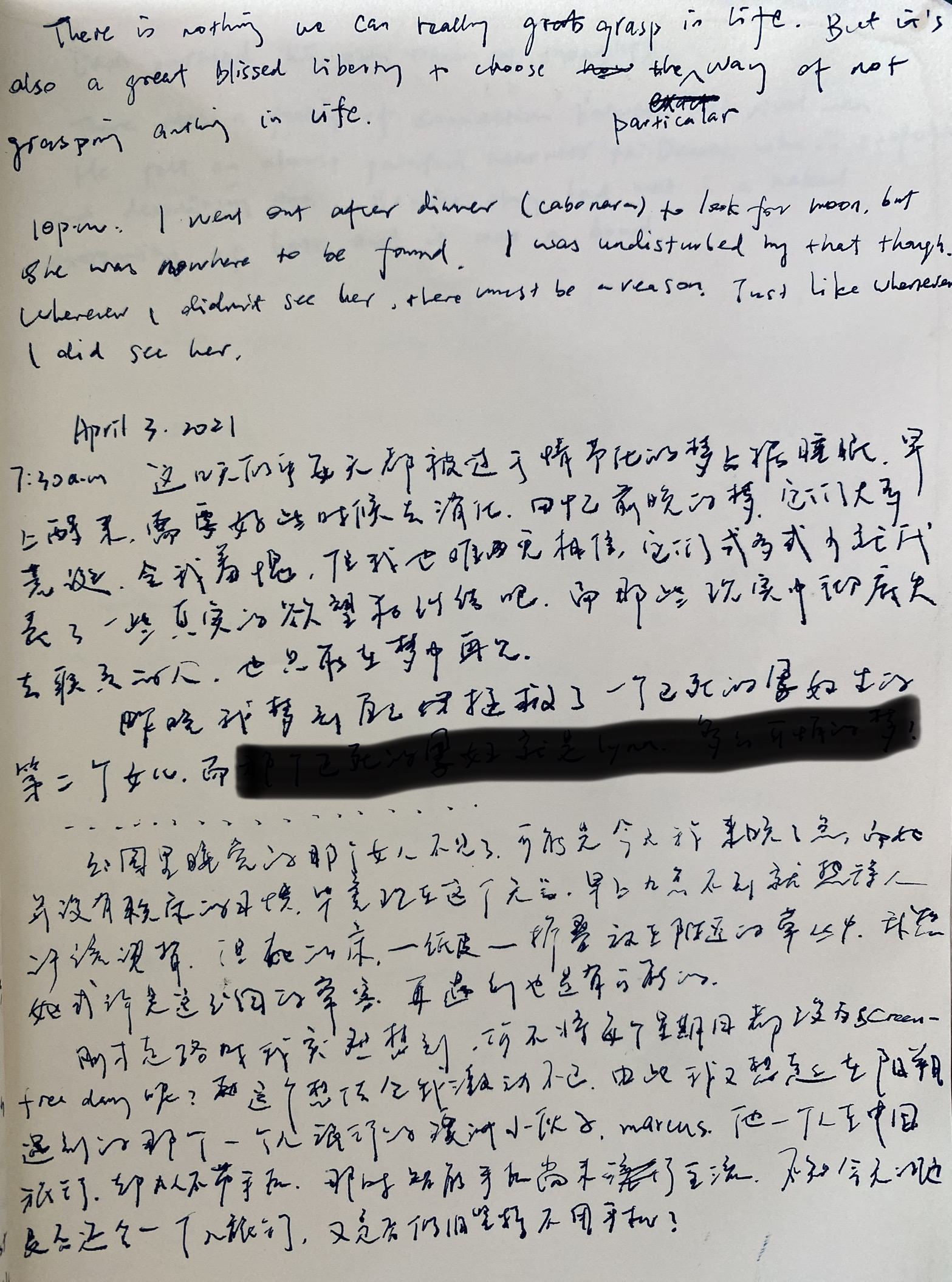
这几天似乎每天都被过于情节化的梦占据睡眠,早上醒来,需要好些时候去消化。回忆前晚的梦,它们大多荒诞,令我羞愧,但我也难免相信,它们或多或少代表了一些真实的欲望和纠结。而那些现实中彻底失去联系的人,也只能在梦中再见。昨晚我梦到自己拯救了一个已死的孕妇生的第二个女儿,并打算领养她。
--------------------
公园里睡觉的那个女人不见了,可能是今天我来晚了点,而她并没有赖床的习惯。毕竟现在这个天气,早上9点不到就热得人汗流浃背。但她的床——纸皮箱——折叠放在附近的草丛中,我想她或许是这公园的常客,再遇到也是有可能的。

刚才走路时我突然想到,何不将每个星期日都设为screen-free day呢?这个想法令我激动不已,由此我又想起在很多年前阳朔的day trip大巴上遇到的那个一个人背包旅行的澳洲小伙子,Marcus。那是2010年,他一个人在中国旅行,却没有一台手机。那时智能手机尚未成为主流,不知道今天的他是否还会一个人旅行,又是否仍旧坚持不用手机?

7:30am:
In the past few days, it seems that my sleep has been occupied by dreams that are too plot-heavy every day. I wake up in the morning and take a long time to digest. Recalling the dreams the night before, they are mostly absurd, which makes me ashamed. Still I can't help but believe that they more or less represent some hidden desires or unresolved issues. It's only in these dreams, that I get to meet again the people who I have completely lost contact with in reality. Last night I dreamed that I saved the second daughter of a woman who died during labor, and planned to adopt her.
--------------------
The homeless woman who slept in the park wasn't there today. It may be that I came a bit later today, and she has no habit of sleeping in. After all, in this weather, one can get pretty sweaty even before 9 o'clock in the morning. But her bed - the cardboard box - was folded and placed in the grass nearby. I think she may be a frequent sleeper in this park, and it is possible to see her again.

When I was walking just now, I suddenly thought, why not set every Sunday as a screen-free day? I was very excited by this idea, along which I randomly think of a young Australian lad named Marcus, someone I met a long time ago on a day-trip bus in Yangshuo. It was 2010. He was backpacking alone in China, but insist on not having a mobile phone. Back then, smart phones weren't the dominating mainstream yet. I wonder if he still travels alone today, and if he still insists on not using a mobile phone on the road?
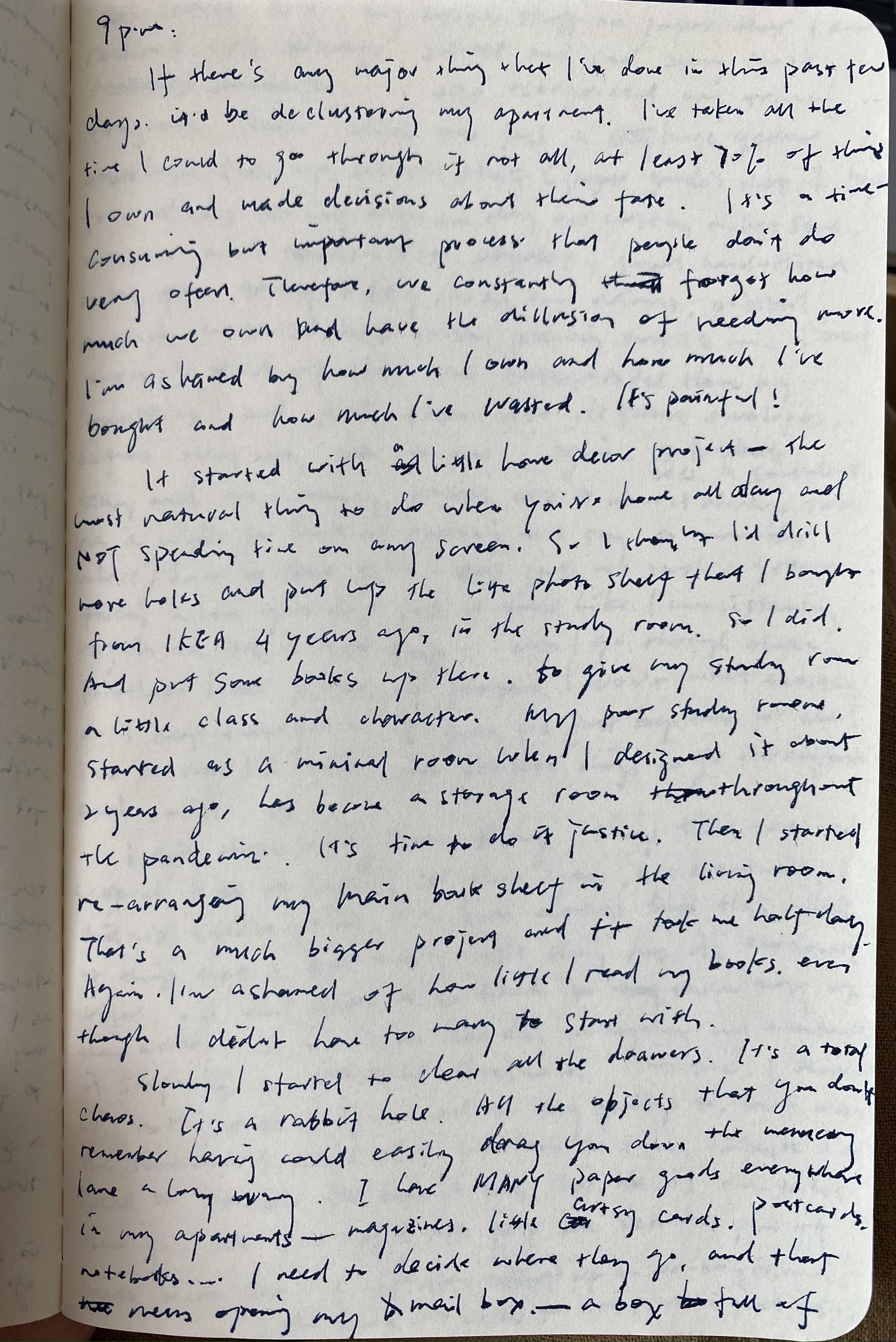
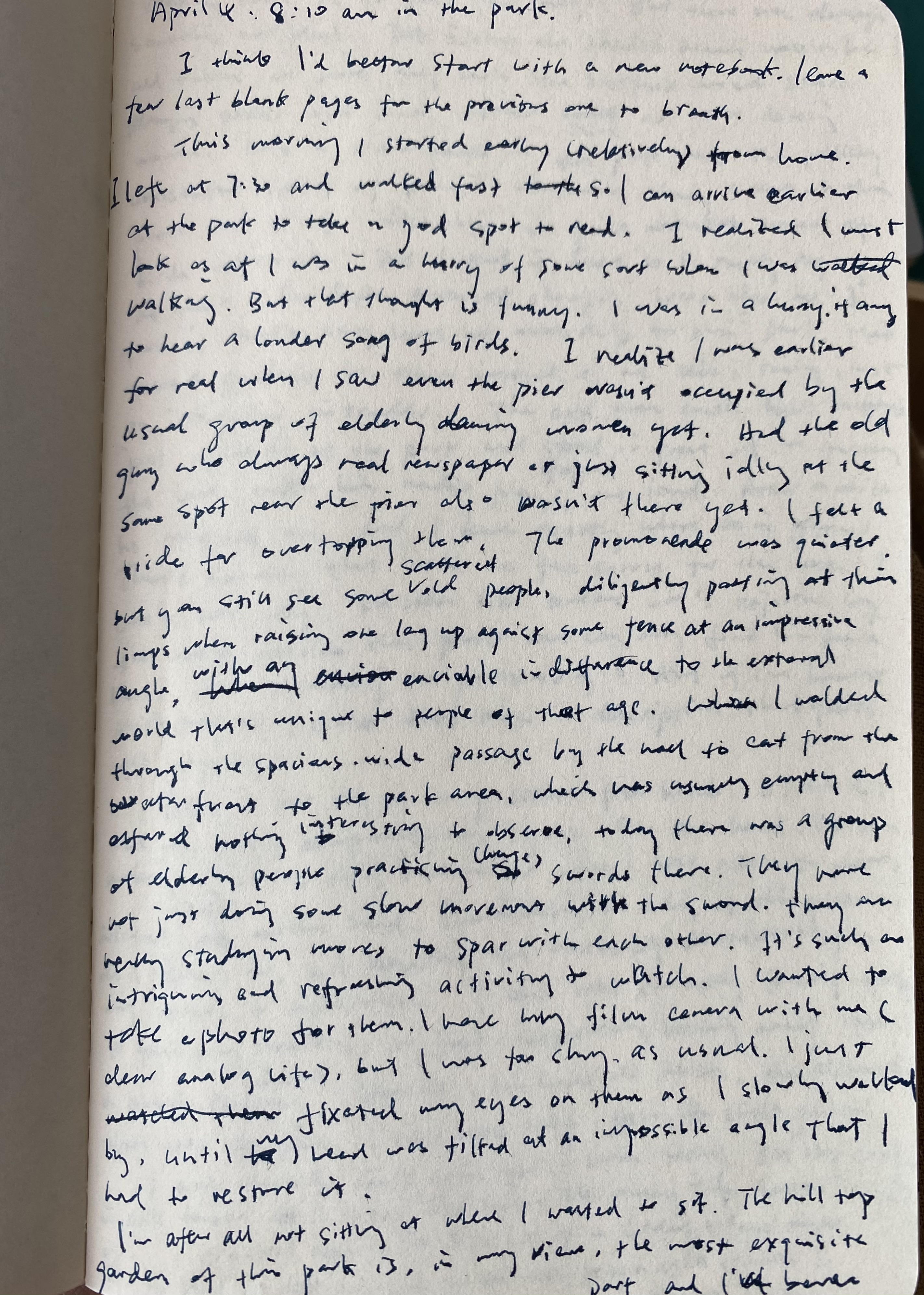
April 4: 8:10am in the park I think I'd better start with a new notebook, leave a few blank pages for the previous one to breathe. This morning I started early (relatively) from home. I left at 7:30 and walked fast so I can arrive earlier at the park to take a good spot to read. I realized I must look as if I was in a hurry of some sort. But that thought is funny. I was in a hurry, if any, to hear a louder concert of birds. I noticed I was early for real when I saw even the pier wasn't occupied by the usual group of elderly dancing women yet. And the old guy who always read newspaper (or just sit idly) on the same bench near the pier also wasn't there yet. I felt a pride for overtopping them. The promenade was quieter, but you still see some scattered old people, diligently patting at their limps when raising one leg up against some rail at an impressive angle, with an enviable indifference to the external world that's unique to people of that age. When I walked through the spacious, wide passage by the mall to cut from the waterfront to the park area, which was usually empty and offered nothing interesting to observe, today there was a group of elderly people practising (huge) swords there. They were not just doing some slow movement with the sword, they were really studying moves to spar with each other. It's such an intriguing and refreshing activity to watch. I wanted to take a photo for them. I have my film camera with me (dear analog life), but I was too shy as usual. I just fixated my gaze on them as I slowly walked by, until my head was tilted at an impossible angle that I had to restore its direction. I'm after all not sitting at where I wanted to sit now. The hill top garden of this park is, in my view, the most exquisite part and I've been reading there in the past few days. But there was always something not ideal. Either the shaded bench would be all taken, or some guy with a blue backpack would start playing radio out loud - either him or some dancing women. It's a shame people in this park have the publicly consented habit of playing whatever they want on their phones, out loud, overshadowing the natural soundtracks quietly flowing in the background. But I find it hard to be really angry with them. (I'm deeply annoyed though.) Becoz after all, I feel if there's any level of ownership of this park, it would probably be with them instead of me, who's really just an irregular intruder. As I'm writing now, on a bench by the lake, the odd man with blue backpack just arrived at the park and stopped in front of where I'm sitting at, facing the lake, with his radio playing out loud. After a while he marched on (and I know exactly where he's going). There's something that makes me feel sorry for this man. I can't tell why. He seems like someone who's hardly accepted by the world outside this park and can only find his peace here. Am I sounding too patronising? And if I'm honest with myself, isn't that also a description that quite fit myself? Today is the last full day of my screen-free retreat. It's hard to tell my feeling comprehensively. On one hand, I've been making a mental list of things I wanna do when I regain access to internet. On another hand, I'm dreading the end of this quietness, as I always do, and dreading the rush-in of distractions upon my return to civilisation. I can't tell whether I'm really forcing myself to face my personal reality, or just desperately running away from a public reality. Overall, I didn't do much, and although that was the plan, I still can't help feeling a little guilty. I was thinking about going for a swim today. But my calf still hurts from the muay thai training several days ago. I finished reading <The portrait of a lady> last night. The level of details of this journal may be considered as a tribute to Henry James.9pm: If there's any major thing I've done in the past few days, it'd be decluttering my apartment. I've taken all the time I could to go through if not all, at least 70% of things I own, and made decisions about their fate. It's a time-consuming but important process that people don't do very often. Therefore, we constantly forget how much we own and have the delusion of needing more. I'm ashamed by how much I own, how much I've bought and how much I've wasted. It's painful to be reminded of that. It started with a little home decor project - the most natural thing to do when you're home all day and NOT spending time on any screens. So I thought I'd drill more holes and put up the little photo shelf that I bought from IKEA 4 years ago, in the study room. I did. I placed some books up there, to give my study room a little class and character. My poor study room, started as a minimal existence when I designed it about 2 years ago, has become a storage room throughout the pandemic year. It's time to do it justice. After I was done with study room, I started re-arranging my main bookshelf in the living room. That's a much bigger project and it took me half day. Again, I'm ashamed of how little I read the books on my shelf, even though I didn't own too many to start with. Slowly I moved on to clear all the drawers. It's a total chaos. It's a rabbit hole. All the objects that you don't remember having could easily drag you down the memory lane a long way. I have MANY paper goods everywhere in my apartment - magazines, little artsy cards, postcards, notebooks...I need to decide where they go, and that means opening my mail box - a box containing all the letters, cards, any written stuff on paper that I ever received from people I was once close with. It's always sweet and sad seeing those memories. I also re-organized my travel fragments folder, which was just a huge yellow envelop full of all the stuff (paper goods) that I kept from many of my trips. They are mostly ticket stubs, museum and tourism site pamphlets, small handwritten notes from strangers (eg, a taipei taxi driver who wanna introduce his son to me), printed research material and travel planning emails......I went through each of them, categorised them by countries, and put them into different envelopes, before they all went into one. Again, it's a somewhat silly and time-consuming process, coz it almost always takes me a while to look at something and try to remember where/how it came from. But god, it's such a great feeling when I do, coz it feels like I can instantly regain the joy from that trip. When I went through these pointless little pieces of papers, I couldn't help asking myself what exactly do I keep these for? I guess I'd just keep them for when I'm 80 years old I'd have some obsolete things to go through and smile at. I did throw away many things, things that survived several times of moving all these years, but eventually didn't make it this time. I've always had this fetish of things that I feel every single thing has its emotional value, and that makes it so hard to throw any of them away. So I've been hoarding everything and eventually it surpassed a threshold of practicality. This time, I decided it's not only the things that I need to say goodbye to, but also the sentimental value I attached to them. Maybe I've held on to them long enough that it's time to let them go.
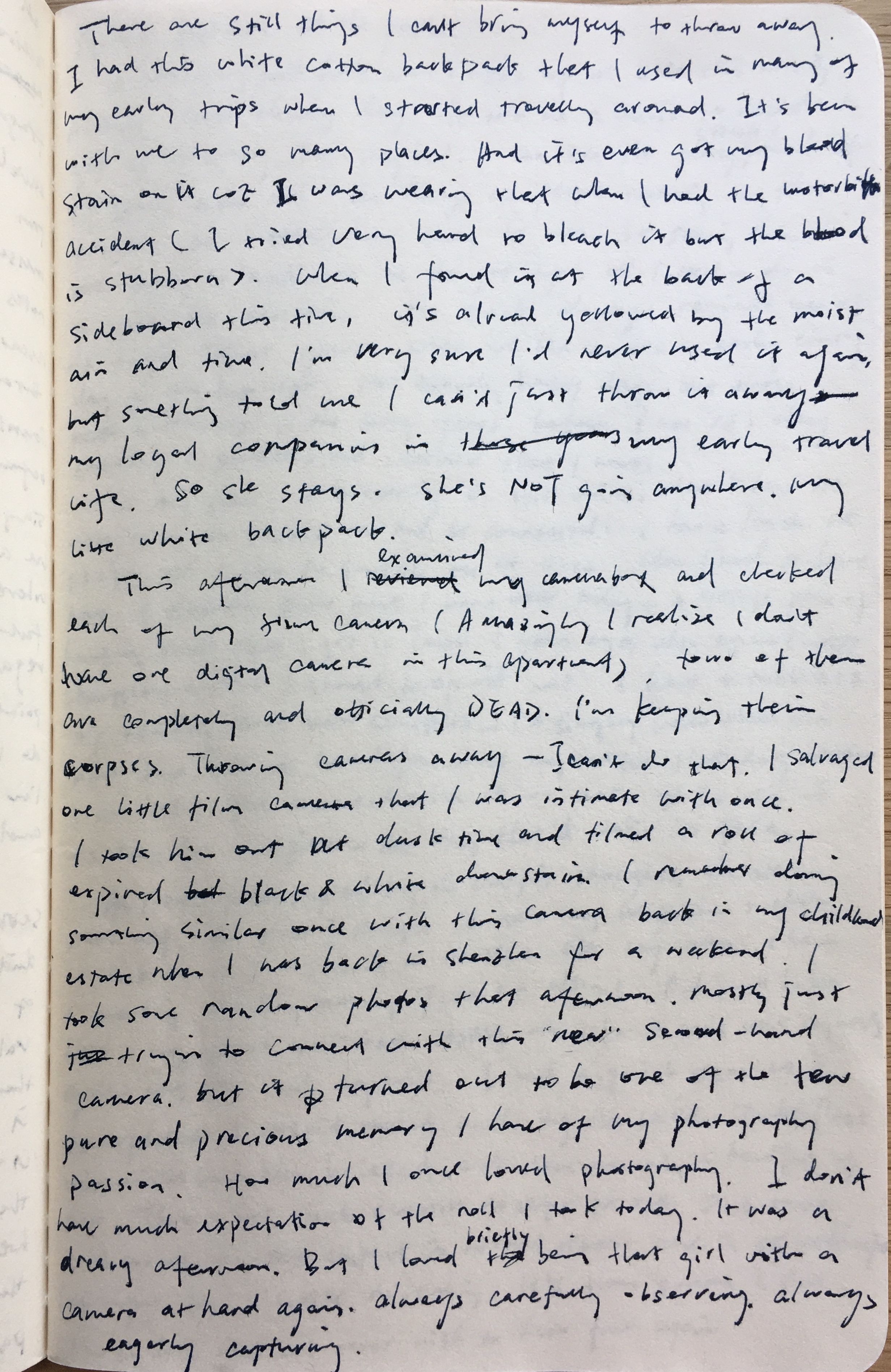
There are still things I can't bring myself to throw away. I have this white cotton backpack that I wore in many of my early trips when I started travelling around. It's been with me to many places. It's even got my blood stain on it coz I was wearing that when I had the motorbike accident. (I tried very hard to bleach it but the blood is stubborn.) When I found it at the back of the bedroom sideboard this time, I'm very sure I'd never use it again, but something told me I can't just discard it, my longest companion in my young travel life. So she stays. She's NOT going anywhere. This afternoon I examined my camera box and checked each of the film cameras (amazingly I don't have one digital camera in this apartment), two of them are completely and officially DEAD. I'm keeping their corpses. Throwing cameras away - I just can't do that. I salvaged one little film camera that I was intimate with at one point. I took him out at dusk time and filmed a roll of expired black and white downstairs. I remember doing something similar once with this same camera in my childhood estate when I was back in Shenzhen for a weekend some years ago, not long after I just bought it. I took some random photos that afternoon, mostly just trying to connect with this "new" second-hand camera. But it turned out to be one of the few pure and precious memories I have of my photography passion. How I once loved photography. I don't have much expectation of this roll I took today. It was a dreary afternoon. But I loved briefly being that girl with a camera at hand again. Always carefully observing, always eagerly capturing.
April 5, 8am at the park

It was way too dark when I woke up at 6:30 this morning. Another gloomy cloudy day. It took me a while to decide to get up officially. From my bed, I can see the athletic field of TY sports center and I can always see people running on the track, no matter how early it is. So seeing them is one way to motivate me to get up - all I need to do is open the curtain. The track always reminds me of the high school years, when we had to train early every day and run two lapses. Not exactly happy days, but those "bitterness" before I was 18, embodies a pureness and innocence that is deeply missed.

In my plan, this morning is still mine, where I have no obligation to switch on or be connected. I have a lunch at 12:30 and I plan to switch on at 11:30, when I need to leave home. I already know what I wanna wear today - a vintage pair of overalls that I got in Taipei 3 years ago, also a piece I'm struggling whether I should keep or not. I have a trick (?) of deciding about these struggles - I'd simply wear them one more time and see how I feel about my outfit that day, whether I can still feel connected with it or not. So this is the day for this pair of overall - the day that'd make its fate.

As I was preoccupied by the outfit thoughts, the alarm in my phone went off. At first I thought it was my neighbours' alarm. It took me a few seconds to realize it's my own. I have a weekly Monday morning 7am alarm! And just like that, my phone switched itself on, like it just can't wait anymore, against my plan and my will. I took a quick scan at it. As expected, I wasn't missed much by the world. Those who might would have been briefed, and there are only a handful of them. There's not much surprise except for one. A text I wouldn't even expect in normal times, came in at midnight last night.

I left the apartment quickly after that, refusing to let that text disturb me more than it should. The text reads, I don'd know why I never find closure with you. If there's anything I've learned from my past relationships, it's that no one owes anyone any closure. Closures isn't something you can be specific with the way you want it, and it has to be found from within.

I left the apartment as a gesture of leaving the unwanted trouble behind. I have a more urgent eagerness to be outside -- at the waterfront, in the park, breathing the air together with the early risers and the birds. That's where I wanna be!

I took the same route to see whether I can still find the sword practising group again. And there they were. I took a closer look today. There are ten of them, nine men, one woman. One/two of them still have black hair, but who knows if that's natural or not. And one younger guy was just there to film, not practise. They are such an interesting and vibrant group of elderlies, and I feel they are like acquittances already today. I figure, since I now know about their venue and schedule, I'd never lose them again. I can always reunite with them whenever I want.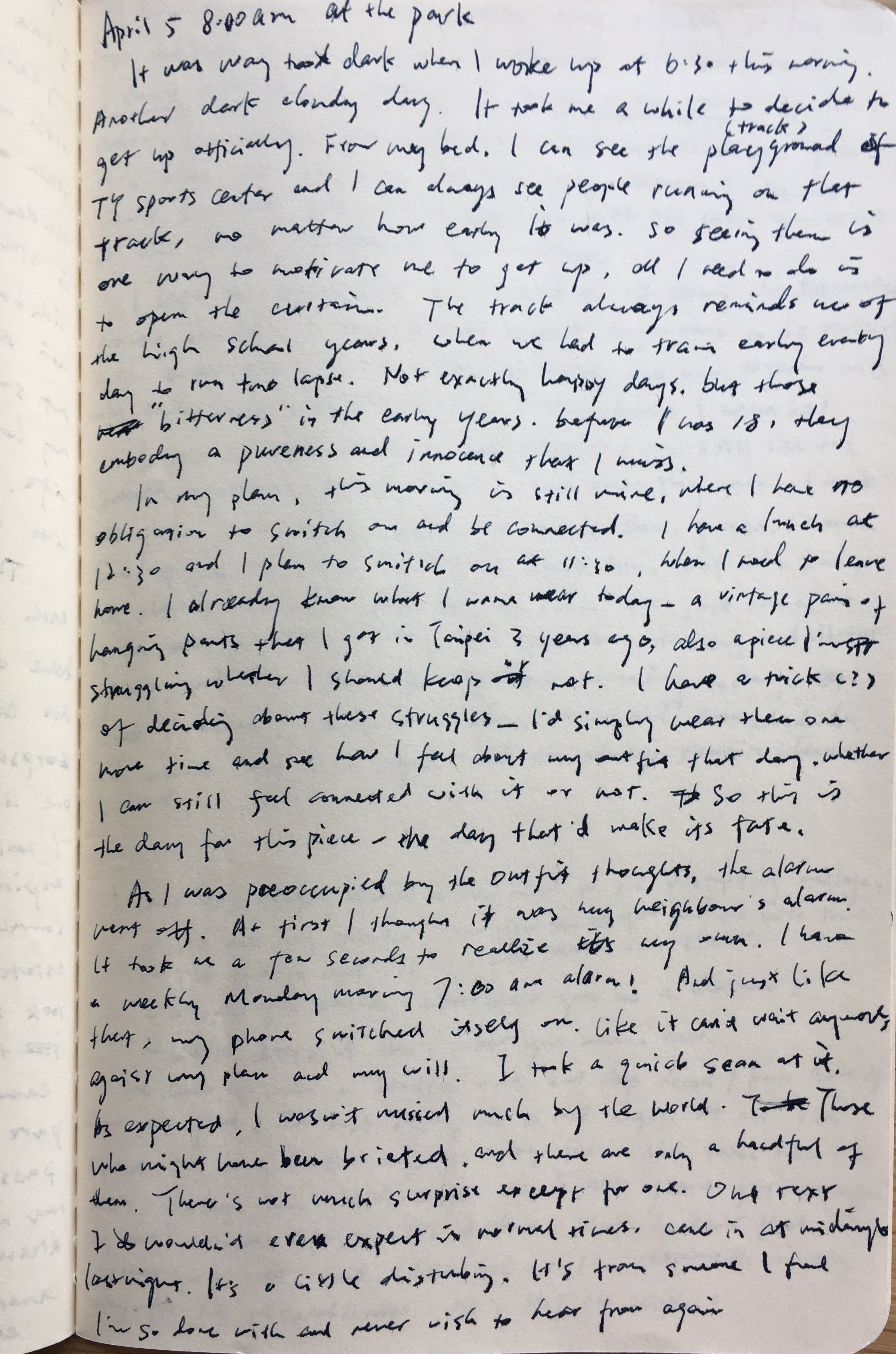

There was more I wrote in the evening on the last day, to process how I felt about the text I mentioned. But I guess that can be left out as it’s drifting away from the original intention of sharing these journals – to lend you a first-row “live” view of those unplugged days, instead of a delayed recollection.
It takes longer than I thought to just transcribe, but by doing that, it feels as if I’ve fast-forwardly lived those days again, something I can’t say I have had enough of. I could only hope that through the tediousness of my texts, I’ve managed to convey an air of tranquility, that is essentially what I wanted to share with you.
You might be wondering about the inconvenience that I have short-listed, on which, indeed I might have something more practical to share. I’ve decided it’s ok to be not guided for my meditation for a few days and instead of the app, I’d put on a vinyl disc of ambient music as a timer. (I have the live album of “Two”, performed by Ryuichi Sakamoto and Alva Noto , which works perfectly as a 20-min timer.) I resolved to the dusted English-Chinese Longman dictionary for unfamiliar words encountered during reading, which I must say, made me feel very nostalgic. I have owned this dictionary since I was in high school and brought it with me when I arrived in Hong Kong 16 years ago. The ludicrousness is I probably used it less in the past 16 years than in those 4 days. I’d play some vinyls when I miss music. Bob Dylan, Teresa Teng, Cat Power, Beatles. I only have a tiny collection of vinyls so I’d just have to settle with whatever I got. The conclusion is, despite some obvious limitations, I’m luckily quite self-sufficient to live an analog life.
Before I end this note, I wanna return to the topic of music a bit. When I do my long walks, I used to usually listen to either podcasts or Spotify playlists. During those days, as the usual options were not available anymore, I’d instead turn to pay closer attention to the sound of nature – birds conversing, kids screaming, train roaring, runners panting, wind flowing. But during this shift of auditory focus, something else was revealed to me. I realized that without music, or the effect of it, I was compelled to walk with my own bare mood, one that is not intervened by any manufactured sentimentality, amplified joy, or condensed intake of information. When walking without music in my ears, I was almost startled at how disconnected I had been with this organic state of mind, as if I’ve been wearing make up on her so habitually that I forgot what she really looks like.
And yet what precisely is this organic state of mind? I’d venture to say it is a very lack of obvious drama, a sense of restraint, and a vast lake of calmness. With that, one would be able to see the greatness underneath the most ordinary and unnoticed existences, and one would be grateful to be fully there with them, for them.
Until the next time.
Ellen


 A clean, well-lighted place.